
Geocache Cache Maintenance for Owners: Step-by-Step
The maintenance process for physical geocaches always follows the same short sequence: check condition, take immediate action, log owner maintenance. Anyone who knows this process and applies it consistently will keep their cache online and the community happy.
On-site, you first need a quick inventory:
- Is the logbook full or wet? Replace immediately.
- Is the container damaged or broken open? Secure temporarily or replace.
- Are camouflage elements missing or has the environment changed? Adjust camouflage.
- Is there evidence of vandalism? Take photos, disable listing.
- Are trackables present? Check inventory and update in the listing.
The most important principle: An Owner Maintenance Log (OM) is the only official method to remove the red wrench symbol from the listing. Whoever has completed the maintenance logs it immediately afterwards, not before.
Key Takeaways
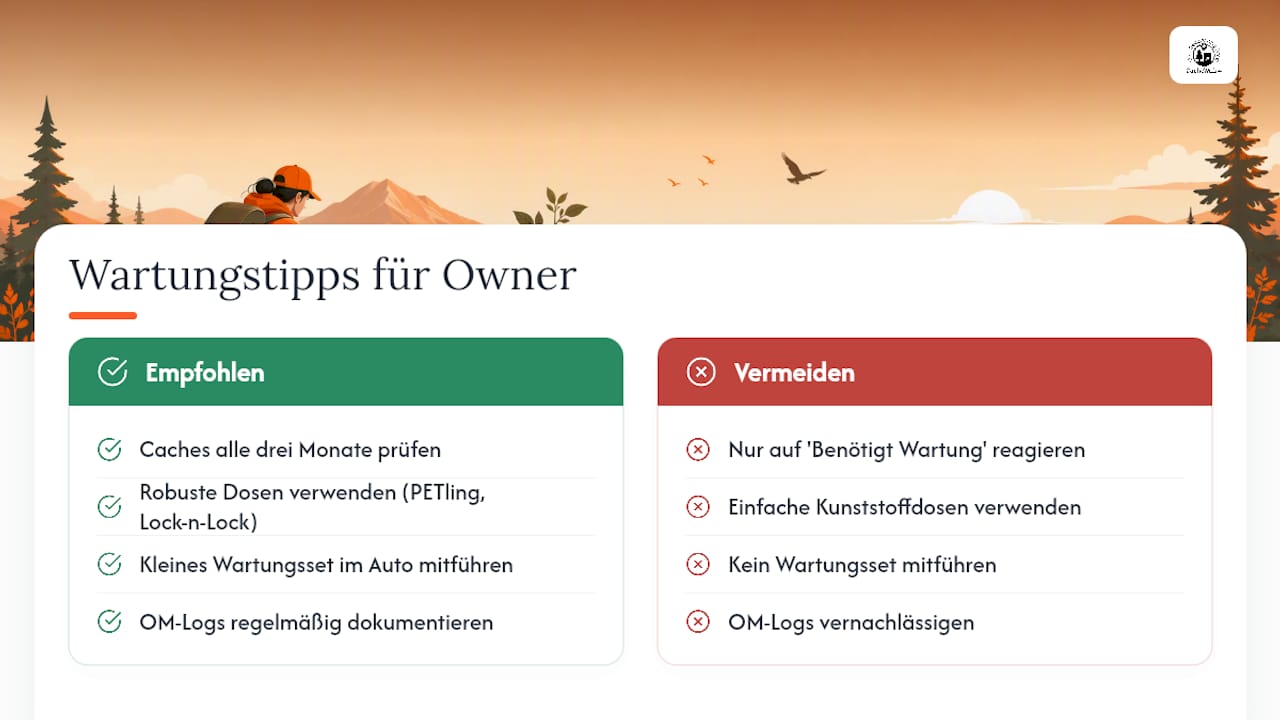
Anyone who regularly checks their cache, acts immediately, and documents every maintenance visit with an OM log keeps their listing healthy and the community happy.
| Topic | Details |
|---|---|
| Maintenance Process | Check condition, take immediate action, write OM log. |
| Maintenance Frequency | Monthly for highly frequented caches, quarterly for quiet locations. |
| OM Log as Obligation | Only log after maintenance is completed; removes the red wrench symbol. |
| Material Selection | PETling and Lock-n-Lock containers withstand frost and UV radiation permanently. |
| Cachewerk | Starter bundles and Crossbody Bag provide everything for a complete maintenance tour. |
Table of Contents
- How does the cache preservation process work step by step?
- What belongs in your maintenance kit?
- What do you do if the cache is damaged, wet, or vandalized?
- When to log what: "Needs Maintenance", DNF, and Owner Maintenance
- How do you design a cache that requires less maintenance?
- When should you archive, relocate, or adopt?
- Practical templates for maintenance and logs
- What I learned after years of hiding geocaches
- Cachewerk products for durable maintenance tours
- Sources
How does the cache preservation process work step by step?
Preparation at home
Open the Owner Dashboard and filter by "Last Maintained" and "Last Found." This quickly shows you which caches urgently need attention. Read all current finder logs, especially DNF entries and "Needs Maintenance" reports. Pack your maintenance kit (see section below) and plan your route to tackle several caches in one tour.
On-site inspection
- Check exterior: Cracks, deformations, rust marks on the lid?
- Test tightness: Close lid, shake briefly, check for moisture inside.
- Inspect logbook: Full, wet, or illegible? Replace.
- Review contents: Mold, moisture, missing trackables?
- Camouflage and fastening: Is the magnet still holding? Is the mount stable?
- Spot-check coordinates: Let GPS run briefly, is the position still correct?
- Assess muggle risk: Has the environment changed (construction site, new paths)?
Immediate measures on site
- Wrap logbook in a zip bag and replace.
- Remove wet contents, wipe container dry.
- Replace damaged container with a spare from stock or provisionally secure with tape.
- In case of vandalism: Take photos, immediately disable listing, decide on relocation.
Follow-up
Write the Owner Maintenance Log on the same day. Upload photos. Update coordinates or listing description if necessary. Enter the next maintenance date directly into your calendar.
Pro Tip: Plan a short maintenance time for a micro-cache, and proportionally more time for a multi with repair needs. Realistic estimation avoids follow-up appointments.
What belongs in your maintenance kit?
Regular maintenance requires you to have the right spare parts. UV radiation and frost make simple plastic brittle, so a well-stocked kit is worthwhile.
Indispensable Basics:
- Replacement logbooks (suitable for your cache sizes), more on this in the Logbook Practical Guide
- Zip bags in various sizes for moisture protection
- Waterproof pen and pencil as backup
- Adhesive tape (weatherproof)
- Disposable gloves
- Multi-tool or small tools
Special parts for common repairs:
- Replacement containers (PETling, Lock-n-Lock)
- Magnetic mounts and hangers
- Sealant or sealing tape for screw caps
- Small camouflage elements (bark, moss, stone-look foil)
If you manage several caches, it's best to opt for pre-packaged bundles. The Geocaching Starter Bundle 1 – PETling + Logbook + Mount provides everything for a complete replacement in one package. The Geocaching Starter Bundle 2 – PETling + Logbook + Hanger is particularly suitable for caches on trees or railings. And the Crossbody Bag for Geocachers with Opencaching-Logo keeps spare parts, logbooks, and small items ready at hand without interfering with walking.
What to look for in material selection: UV resistance, watertightness of the closure, and a mechanism that can be operated even with gloves.

What do you do if the cache is damaged, wet, or vandalized?
Wet Cache: Replace logbook immediately, wipe container dry inside. If the cache itself is leaky, insert a waterproof replacement container. Later, replace it with a higher quality container that withstands frost and rain permanently. Information on robust geocache containers helps with selection.
Vandalism or Theft: Take photos, temporarily disable listing. Only write the Owner Maintenance Log after full restoration. If the location is repeatedly affected, seriously consider relocation.
Damaged Container: Secure provisionally with a zip bag and tape so finders are not confronted with a broken cache. Insert a replacement container from stock if available.
Changed Camouflage or Environment: Re-evaluate seasonal visibility. What is invisible in summer can become conspicuous in winter. Adjust or supplement camouflage elements.
Pro Tip: Complete small repairs entirely on the first visit. Having spare parts saves you a follow-up trip. A second visit often costs more time than the repair itself.
When to log what: "Needs Maintenance", DNF, and Owner Maintenance
Clear rules save misunderstandings and keep the listing clean.
Finders log "Needs Maintenance" for a full logbook or damaged container. A DNF is appropriate if the cache was not found despite a serious search, but there is no obvious damage.
Owner Maintenance Log (OM):
- Complete maintenance entirely.
- Write OM log in the listing, including date, steps taken, and spare parts used.
- Attach photo.
- The red wrench symbol automatically disappears.
Important: OM logs serve as proof for reviewers and the community. Private messages to reviewers do not replace public logs. Anyone who only posts an announcement without having completed the maintenance is misusing the OM log.
Furthermore: Maintenance by finders does not replace owner maintenance. A "throw down" can change the original intention of the hide and only shifts the problem.
Example Logs (copy-ready):
- DNF: "Searched for 30 minutes today, unfortunately without success. Coordinates checked, no obvious damage visible."
- Needs Maintenance: "Logbook full, no more space to sign. Container externally intact."
- Owner Maintenance: "Maintenance on [Date]: Logbook replaced, container dried, camouflage adjusted. Cache is fully functional again."
Pro Tip: Always include a photo with the OM log. This builds trust with reviewers and shows the community that you are active.
How do you design a cache that requires less maintenance?
Good preparation when hiding saves a lot of effort later. Regular maintenance remains mandatory, but robust materials and clever placement significantly reduce the frequency.
- Container: PETling and high-quality Lock-n-Lock containers are frost- and UV-resistant. Screw caps with sealing rings reliably keep moisture out.
- Camouflage: Plan for seasonal visibility. What is invisible in summer can become conspicuous in winter. Realistically assess muggle frequency at the location.
- Mounting: Magnetic mounts and stable hangers prevent the cache from slipping in wind or rain.
- Cache Type and Frequency: A micro in a busy city square needs more frequent logbook changes than a regular in the forest. Consider frequency when planning.
- Seasonal Checks: Spring and autumn are critical times. Forestry work, wildlife movement, and floods can render locations unusable.
A robust initial setup with high-quality containers improves cache health long-term and strengthens the community's trust in your listing.
When should you archive, relocate, or adopt?
Not every cache can be maintained indefinitely. Clear criteria help with the decision.
- Disabling is the temporary solution: for construction sites, seasonal closures, or if you temporarily cannot perform maintenance.
- Archiving is permanent: if the location is permanently unsuitable, you repeatedly cannot perform maintenance, or the cache has been stolen multiple times.
- Relocating is worthwhile if the cache itself is good, but the location has become problematic.
- Adoption allows finding another owner. Listing changes must be synchronized across all used platforms.
Legal notice for Germany: When archiving, you are obliged to remove all remains of the cache. Do not leave permanent fixtures or pollution. The OpenCaching Wiki on Cache Maintenance summarizes the principles.
Practical Templates for Maintenance and Logs
Maintenance Checklist
| Field | Content |
|---|---|
| Date / Time | e.g., March 15, 2026, 10:30 AM |
| Container Condition | intact / cracked / leaky |
| Logbook | full / wet / replaced |
| Actions Taken | e.g., logbook swapped, camouflage adjusted |
| Spare Parts Used | e.g., PETling, zip bag |
| Photos Taken | yes / no |
| Follow-up Date | e.g., next check in June |
Example Owner Maintenance Log (extended)
"Owner Maintenance on [Date]: Logbook was full and slightly damp. New logbook inserted, container dried inside. Camouflage renewed after winter damage. Cache is fully functional again. Next planned check: [Date]."
Plan maintenance intervals according to the importance and visitor frequency of your cache, e.g., more frequently for busy caches and less frequently for quieter ones. Additional checks after seasonal changes are recommended. Enter the dates directly in the Owner Dashboard or your calendar.
More about logbook sizes and replacement intervals can be found in the Logbook Overview at Cachewerk.
What I learned after years of hiding geocaches
The most common mistake I observe among owners: They only react when a "Needs Maintenance" log appears. Those who check quarterly, however, find problems early and solve them with a single visit. This significantly reduces the archiving risk.
What always surprises me: Many owners underestimate the German winter. Simple plastic containers become brittle in frost, lids break, seals fail. PETling containers and high-quality Lock-n-Lock containers withstand this much better. A small maintenance kit in the car, with a spare logbook, zip bags, and a spare container, has saved me a second trip many times.
And one more thing: The OM log is not a bureaucratic act. It is your proof to the community that you are active. Owners with regular, well-documented maintenance entries rarely have problems with reviewers.
Cachewerk products for durable maintenance tours
Anyone who manages multiple caches knows: a well-stocked spare kit saves time and nerves. Cachewerk offers exactly what you need for a reliable maintenance tour.
The Geocaching Starter Bundle 1 – PETling + Logbook + Mount contains everything for a complete container exchange on site. The Geocaching Starter Bundle 2 – PETling + Logbook + Hanger is suitable for caches on trees or railings. And the Crossbody Bag for Geocachers keeps your maintenance kit handy without interfering with walking. Check out the bundles directly in the Cachewerk shop and pack your kit for the next maintenance round.
Sources
- Make the most of cache maintenance with the new cache owner page – Official Blog
- Cache Maintenance – CacheWiki
Recommendation
- Maintaining a cache: A practical guide for long-lasting geocaching fun – CacheWerk
- Maintaining a cache logbook: A practical guide for geocachers – CacheWerk
- Understanding cache containers: Function, advantages, and practical tips – CacheWerk
- Improving geocache durability: The practical guide – CacheWerk