Caches in winter: When to disable, when to winterize?

Only deactivate a cache if it is dangerous for seekers or simply unreachable. In all other cases, it is worth winterizing it: place it higher, double-wrap it, and use a weatherproof logbook. Seekers, in turn, need three things in their backpack for winter caching: warm layers, spare batteries, and a pencil. Plus a plan for the way back before it gets dark.
In a nutshell:
- Caches should only be deactivated if there is a risk of frost or they are unreachable; otherwise, winter-proof packaging is worth the effort.
- For sensitive electronics, spare batteries and a power bank are essential, as cold significantly reduces battery performance.
- When searching in snow, careful uncovering and patient waiting for frozen lids helps avoid damage.
- Owners should protect hides with double shells, higher placement, and a waterproof logbook to prevent frost and water damage.
- In extreme weather like storms or freezing rain, it is better to abort the search or wait for safe conditions.
Table of Contents
- Safety First: How to Prepare Properly
- The Right Equipment for Winter Caches
- How to Find Caches Under Snow and Ice
- Winterizing Caches: What Owners Should Do Now
- How to Plan Realistic Winter Trips
- Winter Trails and Advent Series in Geocaching
- CacheWerk Practice: Suitable Products and Instructions for Winter
- How to Protect Yourself from Frostbite While Caching
- How to Behave During Storms or Freezing Rain
- How to Care for Your Equipment After Winter Use
- Nature Conservation During Winter Caching: What to Keep in Mind
- In a Nutshell: My Priorities During Winter Caching
- Winter Equipment and Winter-proof Hides from CacheWerk
- Sources
- FAQ
Safety First: How to Prepare Properly
If you want to head out in sub-zero temperatures, you need more than a good mood. The layering principle is not just a phrase here, but the basis of any winter equipment: a moisture-wicking layer directly on the skin, insulation on top, and weatherproofing on the outside. In winter, sweat is the real enemy, not the cold itself. Anyone standing in a gust of wind while drenched in sweat will dangerously lose body heat in minutes.
Black ice and hypothermia often creep up on you. Shivering, slurred speech, or sudden exhaustion are warning signs that you should turn back immediately, no matter how close the cache is. A simple rule helps: as soon as you realize that the way back might take longer than planned, it is time to go, not to hunt for another container.
Tell someone where you are going and when you intend to be back. It costs one text message and, in an emergency, saves time that counts.
Basic equipment includes:
- Headlamp with spare batteries
- First-aid kit, packed for winter
- Emergency blanket and hand warmers
- Fully charged phone, protected from the cold in an inner pocket
Pro Tip: Set a fixed "turn-back time" before you start, for example, an hour before sunset. You decide on this rule at home at the warm table, not while on the go when ambition kicks in.
The Right Equipment for Winter Caches
Cold kills batteries faster than many think, and ballpoint pens often fail completely in frost. That is exactly why the official Geocaching blog recommends spare batteries for the GPS device and a pencil instead of ink in your backpack. A power bank in an inner pocket additionally keeps your phone and GPS device ready for use longer, as body heat delays discharge.
On the packing list:
- Spare batteries and power bank, stored close to the body
- Pencil instead of ballpoint pen, plus weatherproof replacement paper
- Small shovel or spatula for frozen lids
- Magnet for checking possible nano-hides under snow
- Waterproof shoes with good grip
At temperatures below zero, a standard GPS battery loses performance significantly faster—an effect many winter cachers have already experienced. Keeping your upper body warm also benefits the device. A Sherpa jacket from Cachewerk is suitable as an outer layer for stationary searching, while a premium hoodie works as a warm mid-layer under a jacket.
How to Find Caches Under Snow and Ice
A cache hidden high up and not near the ground remains much easier to find in winter than one that disappears under ten centimeters of snow. This is one of the reasons experienced owners rethink their hides in the fall.
When uncovering, patience counts more than force:
- Gently push snow away, do not kick it with your feet
- For frozen lids, wait a moment or gently pry rather than pulling
- Brittle plastic containers break easily in frost; a crack often makes the cache unusable
- Check cache attributes before leaving; some owners mark winter unavailability
- If in doubt, come back in the spring rather than damaging the container
Anyone who finds a damaged container should note this in the log. The owner can then react before the next seeker faces a broken container.
Winterizing Caches: What Owners Should Do Now
A cache meant to survive the winter needs more than a bag in the bushes. The so-called "cache-ception" has proven successful: a smaller, sealed container is placed inside a second, more robust one. This double shell protects the logbook even if the outer packaging draws in moisture, as the Geocaching blog explains.
Specific tips that help:
- Raised placement instead of ground level so snow does not completely cover the cache
- Secure fastening via magnet or small lock so wind and animals do not move things
- A truly waterproof logbook; PETling containers are often more reliable here than simple bags
- Regular checks after heavy snowfall or thawing
If a hide is simply no longer safely accessible due to snow, ice, or blocked access, it should be temporarily deactivated, with a brief note in the description about when it will be accessible again. Pro Tip: Include how you handle winter conditions in your cache description back in the fall. This saves you ten messages from disappointed seekers in January.
How to Plan Realistic Winter Trips
A kilometer often feels much more strenuous in the cold than in summer, and shorter daylight hours further shorten your time window. If you are still in the forest at 4 PM in December, your planning was often too tight.
Here is how you proceed:
- Check the weather forecast and road conditions the night before, not just when leaving
- Plan fewer, nearby caches instead of a long series
- Consciously include a buffer for walking slower in the snow
- Check parking options in advance; some forest parking lots are not cleared in winter
- Schedule your return for before dusk, not after
Anyone who follows this order rarely gets into the situation of having to search for the last cache in the dark.
Winter Trails and Advent Series in Geocaching
Winter series bring movement into the cold season when many would otherwise prefer to stay indoors. Some owners set up daily Advent caches, others publish a complete trail at once to be completed at your own pace. Both formats have their fans, as long as the labeling is clear.
For owners, collaboration pays off:
- Clearly mark whether a series is time-limited or permanent
- Divide maintenance duties within a team, especially for longer trails with many stations
- Inform the community early, for example via forums or local cacher groups
Such series share not only the fun but also the effort that would otherwise fall on a single owner.
CacheWerk Practice: Suitable Products and Instructions for Winter
If you want to build a winter-proof hide, you will find both suitable materials and specific instructions at CacheWerk. The tutorial on building a weatherproof hide shows step-by-step how to set up a double shell. For magnetic fasteners that hold even in frost, take a look at the instructions for mounting PETling magnets, as neodymium magnets without corrosion protection age faster in winter.
On the clothing side, the Sherpa jacket and premium hoodie remain two practical options if you are standing outside and searching for longer periods instead of just walking. Both are comfort solutions, not high-end mountaineering jackets, but just right for hours of searching in the undergrowth.
How to Protect Yourself from Frostbite While Caching
Frostbite often occurs on fingers, nose, and ears—exactly the areas that remain unprotected the longest when typing on a GPS device or taking photos. Thin gloves are enough for short movement, but anyone spending minutes fumbling for a nano-cache in the bushes needs warmer models with a good grip; otherwise, the gloves quickly go into the pocket and the fingers are left unprotected.
Hypothermia usually announces itself gradually. First, your movements become clumsier, then shivering sets in, and eventually, concentration fades. If you notice such signs in yourself or fellow cachers, you should abort the search immediately, regardless of how close the cache is.
A few simple rules significantly reduce the risk:
- Plan breaks consciously; warm drinks from a thermos help more than you think
- Change out of wet clothes immediately if water or slush has seeped through
- Bring additional layers for wind; the windchill effect cools you down faster than just the air temperature
- Keep an eye on children and older fellow cachers; they often lose body heat faster than active adults
Those who take these points seriously are more likely to extend their own winter season rather than ending it entirely after an unpleasant experience.
How to Behave During Storms or Freezing Rain
Storms and freezing rain are conditions where the answer is usually simple: stay home. Falling branches and icy paths make even short stretches of forest dangerous, and after all, a cache won't run away.
If you are already on the go and the weather takes a turn, quick reactions count more than ambition. When a storm is brewing: avoid open areas and forest edges, as wind gusts hit hardest there and trees are most likely to fall. With freezing rain, the ground becomes as slick as glass within minutes, especially on paths with even a slight incline. If you notice the return route is iced over, it is better to take a detour over firmer ground than to risk a fall.

Some cachers underestimate how quickly conditions in the forest can change compared to an open road. It often feels quieter under trees, but that is exactly where the danger of falling branches is greatest. A weather app with storm warnings, checked just before leaving, prevents most unpleasant surprises. And for those already on their way when the warning comes, it is better to turn back than to risk the last 300 meters to the cache.
How to Care for Your Equipment After Winter Use
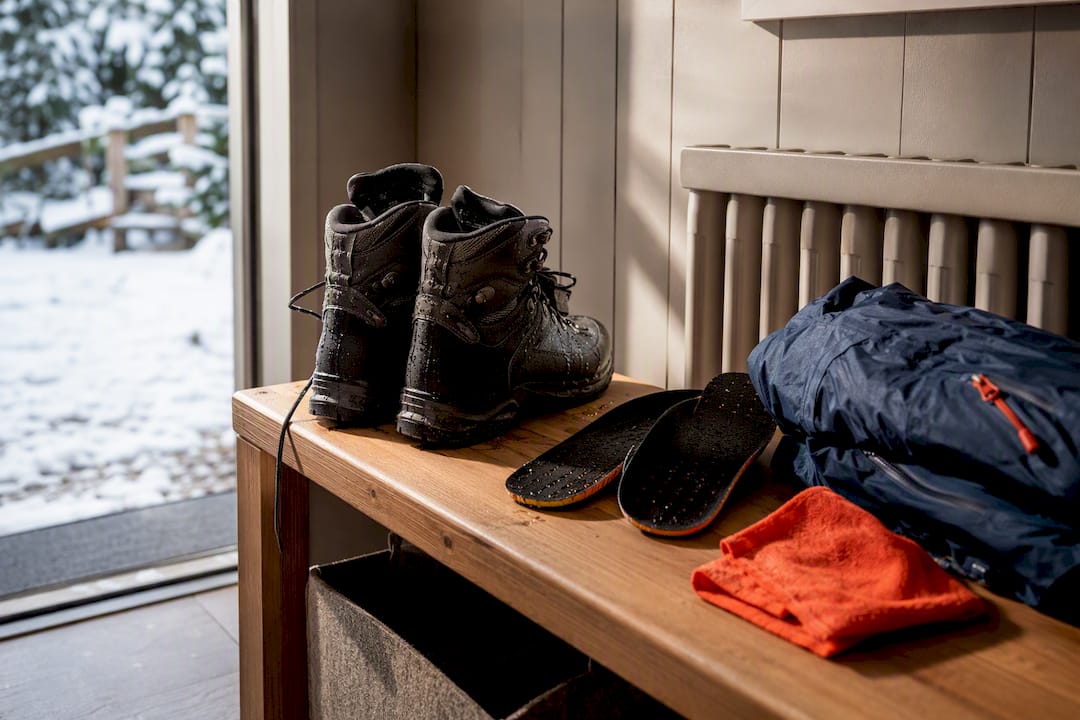
Wet, salt-crusted equipment that simply stays in the backpack ages faster than necessary. After every winter tour, shoes should have their insoles removed and be allowed to dry in the open, but not directly on the heater. Drying too quickly in high heat makes leather and synthetic materials brittle.
Jackets and hoodies with membrane functions cannot handle regular fabric softeners, which clog the pores of the water-repellent coating. A special waterproofing agent after washing renews the protection that many winter jackets lose after a few uses. GPS devices and power banks should only be recharged after reaching room temperature; direct charging while cold measurably shortens battery life.
Small parts like magnets and screws also deserve a look: moisture and road salt promote corrosion on metal parts that spend the whole winter in a backpack or on a cache container. Those who regularly check magnetic mounts significantly extend their durability—a point that counts just as much in cache construction as it does for personal equipment.
Nature Conservation During Winter Caching: What to Keep in Mind
Winter forests often appear emptier, but they are not. Many animals conserve energy in winter and react more sensitively to disturbances than in summer because every escape through deep snow costs additional, scarce energy. Leaving trails to take a shortcut to a cache can do more harm during this time than at any other.
It is also important not to tread new footpaths through protected areas just because the ground happens to feel frozen and stable. Under the snow cover, there are often sensitive plants meant to sprout again in the spring. If you are searching off-trail, you should tread particularly carefully and, if possible, use existing tracks rather than creating new ones.
For the hide itself, the same principle applies as in summer, just with different risks: no hides in bird nests, tree hollows, or densely overgrown shelters that serve as retreats for animals in winter. A cache that disturbs such a hide does more harm than it provides joy.
In a Nutshell: My Priorities During Winter Caching
Safety is more important than any statistic in your profile. That may sound banal, but it is regularly ignored when the last find of the year seems within reach. An analysis of various sources shows a clear pattern: most problems encountered during winter caching are not caused by a lack of equipment, but by unrealistic expectations regarding one's own timeframe and physical endurance in the cold.
If you want to go caching in the winter, it is better to plan for one less cache and return relaxed instead. The cache won't run away; it will wait patiently for you until spring.
— Benedikt
Winter equipment and winter-proof caches from CacheWerk
There are providers who offer well-thought-out clothing for long hours outside and caches that truly withstand frost.
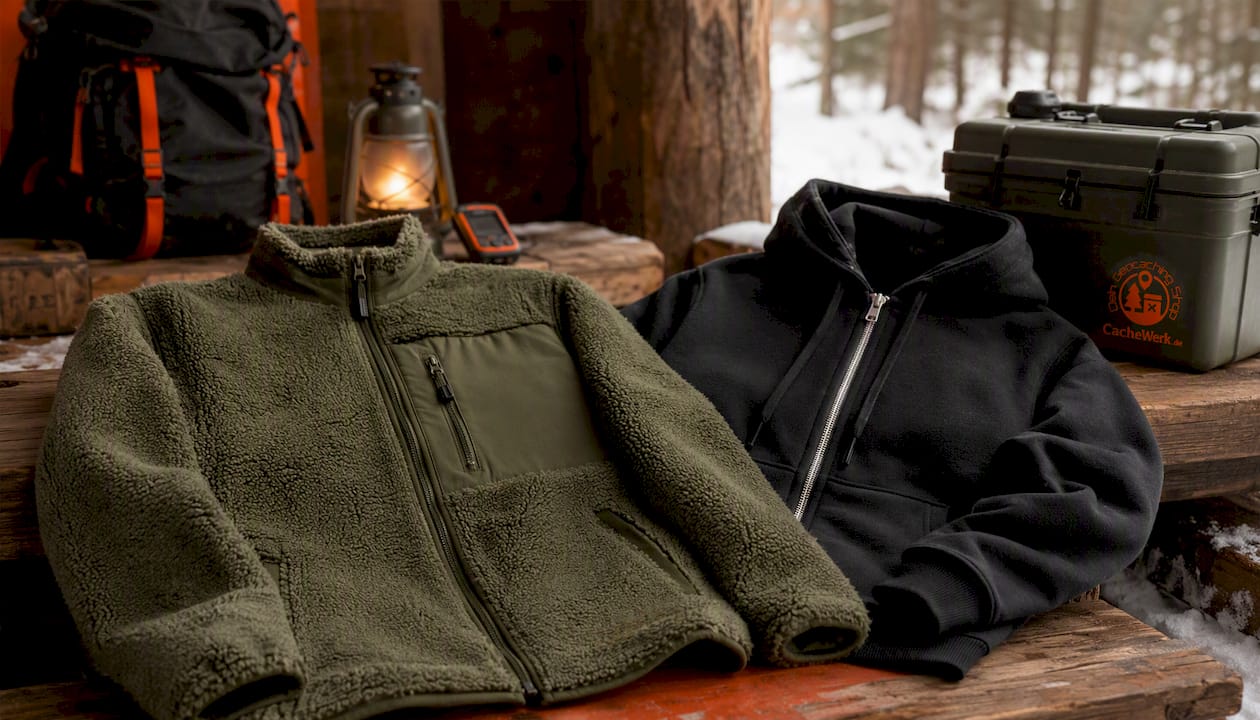
The Sherpa jacket is suitable as a warm outer layer for stationary searching, while the premium hoodie works well as an additional insulation layer underneath. For those who want to build a cache that survives frost, wetness, and thaws, our collection of robust caches and 3D-printed containers offers suitable PETG containers that remain less brittle at low temperatures than standard plastic. For smaller replacement parts, magnets, or weather-resistant logbooks, it is worth taking a look at the geocaching equipment category. Check out the current selection before the next cold snap hits, and equip your winter cache now instead of improvising in January.
Sources
The official Geocaching blog provides the basics on batteries and clothing, and the guide on winterizing explains "cache-ception" in detail. The podcast episode on winter tips provides additional practical experience from the community.
- The 10 coolest winter geocaching tips – Official Blog
FAQ
Does it make sense to disable a cache in winter?
Yes, if access is dangerous, icy, or impossible due to closures. A brief disabling with a note in the description protects seekers and the cache itself.
What does "winterizing" a geocache mean?
Winterizing means protecting a cache against frost, snow, and moisture with double casing, elevated placement, and waterproof logbooks, as described by the Geocaching blog.
What happens if a cache container breaks in the frost?
Plastic becomes brittle at low temperatures and can crack when opened, which is why PETG materials are better suited for winter caches than standard plastic.
What types of winter caches are there?
In addition to classic single caches, there are Advent trails with daily stations and complete winter trails that are released at once and can be tackled at your own pace.
How do I find suitable winter caches nearby?
Using the map view on Geocaching.com, you can filter for caches with the attribute for year-round availability, supplemented by recent logs that indicate snow or ice at the location.