
The Significance of Cacher Events: A Guide for Geocachers
Cacher events are much more than a casual get-together. Anyone who has experienced the importance of cacher events themselves knows: something happens here that no individual caching can replace. What started as small gatherings of a few like-minded people has grown into worldwide major events that bring the entire geocaching community together. The numbers speak for themselves, and the experiences even more so. In this guide, you'll learn everything you need to know about cacher events.
Table of Contents
- What are cacher events and what is their significance?
- Forms and development of cacher events over time
- Organizing cacher events: From idea to successful execution
- Special event types: Understanding Maker Magic and Mega Events
- Success factors for cacher events: What participants truly value
- Perspective: Why cacher events are more than just meetups
- How to perfect your cacher events with the right equipment
- Frequently asked questions about cacher events
Key Takeaways
| Point | Details |
|---|---|
| Social Significance | Cacher events create encounters and strengthen community among geocachers. |
| Diversity of Events | Events range from small meetups to large mega-events with thousands of participants. |
| Early Planning | Successful events require timely registration and careful preparation. |
| Special Event Types | Maker Magic and Mega Events offer creative and large-scale opportunities. |
| Participant Wishes | Good catering, thematic activities, and geocaching-oriented offerings are crucial. |
What are cacher events and what is their significance?
When someone first hears about a cacher event, they might think of it as just another cache to log. That's a misconception. A cacher event is a gathering where social interaction is clearly the priority, not finding a container. The cache merely serves as an occasion and a coordinate point that brings people together.
The difference from a traditional cache is fundamental. With a normal cache, you search alone or with a few companions for a hiding spot. At an event, you meet dozens, sometimes hundreds, of geocachers, exchange experiences, and forge real friendships. This is precisely what makes the significance of cacher events so great for the entire community. The hobby gets a face, and behind every nickname, there's suddenly a person.
Promoting geocaching communities is the central goal of these events. Events create spaces where beginners learn from experienced geocachers and cache owners receive concrete feedback on their hiding spots. This informal knowledge, transferred during an evening at a table, cannot be found in any tutorial.
The most common event types at a glance:
- Meet & Greet: The classic meetup without a fixed program, simply gather, talk, exchange ideas.
- CITO (Cache In Trash Out): Geocaching combined with environmental protection, joint litter collection in nature.
- Flash Mob Event: A short-notice meeting announced at a public place, often lasting a few hours.
- Maker Magic Event: Focus on cache creation and quality, ideal for creative cache owners.
- Mega-Event: Large-scale event with hundreds to thousands of participants, often with an extensive supporting program.
- Giga-Event: The largest category, international events with tens of thousands of participants.
What connects all these formats: people meet because they share a passion. This creates a bond that goes beyond the hobby.
Forms and development of cacher events over time
The history of cacher events impressively demonstrates how much this hobby has grown. What once began with a handful of enthusiasts has evolved into a global movement.
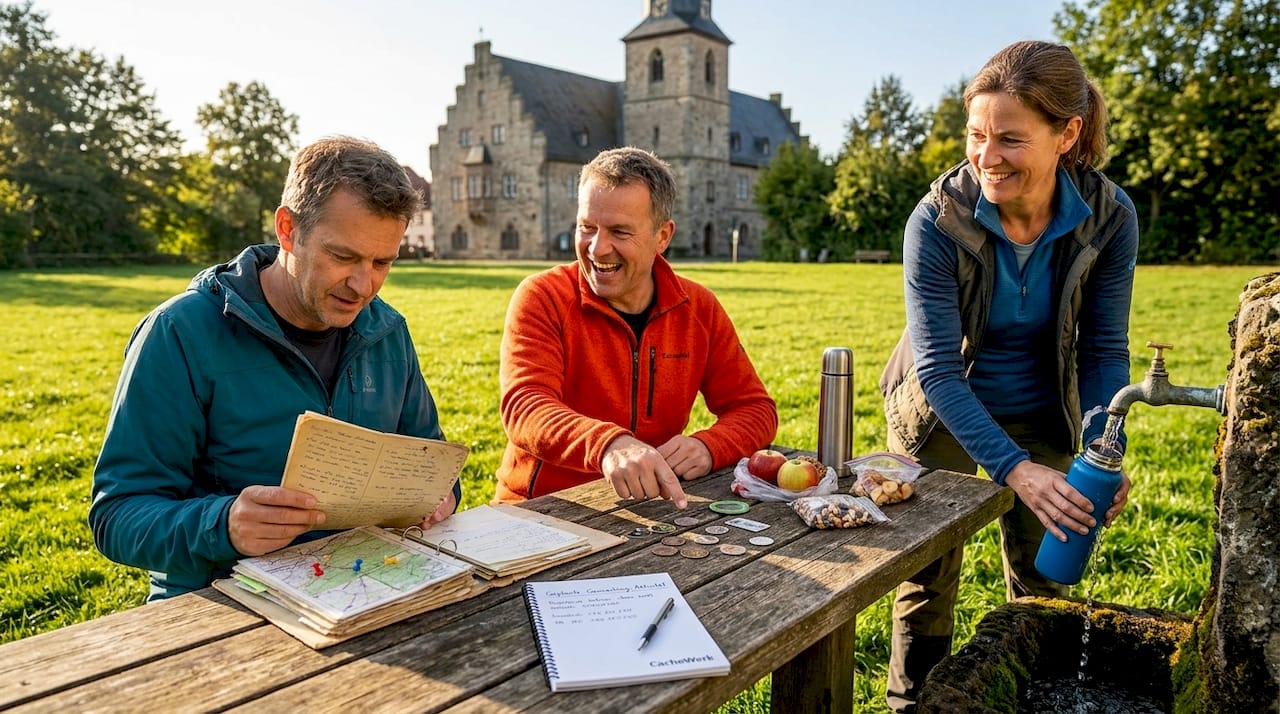
The development in numbers
Events grew from 12 teams in 2001 to events with over 100 teams by 2011. That sounds modest until you see the current numbers. In 2025, 70,844 events took place worldwide, with over a million individual participations. A record year that shows: cacher events are no longer a niche phenomenon.
The most important milestones of this development:
- 2001 to 2005: First local meetups, mostly spontaneously organized, no fixed formats.
- 2005 to 2010: Emergence of official event cache types on the Geocaching platform.
- 2010 to 2015: Mega-events establish themselves, first international major events.
- 2015 to 2020: Flash Mob Events and CITO events increase significantly, community grows worldwide.
- 2020 to 2022: Pandemic-related pause, but also creative digital formats emerge.
- 2023 to present: Record years with growing participant numbers and new event types like Maker Magic.
The different event types today
The evolution of geocaching events has led to an impressive diversity. Today, there is a suitable format for every taste and every group:
- Standard Events: For 10 to several hundred participants, flexible format.
- CITO Events: Nature conservation meets community, officially recognized and popular.
- Mega-Events: From 500 participants, often multi-day with a geocaching program.
- Giga-Events: Only a few worldwide per year, tens of thousands of participants.
- Maker Magic Events: New and growing, focus on handcrafted cache quality.
This diversity is no coincidence. The community has actively shaped what formats it needs. Events have thus become a mirror of the entire geocaching community.
Organizing cacher events: From idea to successful execution
Do you want to organize your first event? Then planning is key. A well-planned event is a joy for all involved. A poorly planned event can frustrate even the most enthusiastic geocachers.
Step by step to your own event
-
Develop an idea and concept: Decide early what format you are aiming for. A small Meet & Greet requires less preparation than a CITO event with 80 people.
-
Secure a location: For larger events, you should obtain the landowner's permission two to three months in advance. Restaurants, parks, or community centers are good options.
-
Submit the event in time: Event caches must be submitted at least two weeks before the date. After the event, you must archive the cache within four weeks. These deadlines are binding.
-
Communicate details: Location, time, parking, program. Interested parties will sign up faster if all information is clear and complete.
-
Plan activities: Consider whether you want to include trackable trading, a small competition, or a joint cache run.
-
Clarify catering: Will drinks be provided? Is there a community fund? Or does everyone pay for themselves? Clear communication avoids misunderstandings.
-
Communication afterwards: Thank the participants, share photos, and collect feedback for the next event.
Pro-Tip: Create a short description in the event listing that directly appeals to newcomers. Explain that no geocaching experience is necessary to participate. This significantly lowers the barrier to entry and brings fresh faces to the community.
The tips for event organization show: the effort is worth it. Once you have organized a successful event, you understand the deep satisfaction that comes from bringing others together.
An often overlooked point is buffer time. Always plan for 30 minutes more than you think you'll need. Geocachers come from all directions, some with GPS devices that lead them down the wrong side street.
Special Event Types: Understanding Maker Magic and Mega Events
Not all events are created equal. Some formats have specific requirements and a special impact on the community. Two of these stand out: Maker Magic Events and Mega Events.
Maker Magic Events
Maker Magic Events must last at least one hour, explicitly deal with cache quality, and can be registered between April 9 and April 30, 2026. This sounds like strict requirements, but it is precisely this structure that makes the format valuable.
A Maker Magic Event is all about craftsmanship. Participants learn how to build better hiding places, what materials are durable, and how to design caches that truly delight finders. For cache owners, this is a direct added value: they go home with concrete ideas they wouldn't have had otherwise.
Mega Events and Giga Events
The large numbers are impressive. In 2025, 143 block parties and mega-events took place, with around 93,000 participants. That's equivalent to a sold-out football stadium, spread across events worldwide.
Comparison of Event Categories
| Event Type | Number of Participants | Special Feature | Planning Effort |
|---|---|---|---|
| Standard Event | 10 to 500 | Flexible, no fixed requirements | Low to medium |
| CITO Event | 10 to several hundred | Litter collection combined with caching | Medium |
| Mega Event | From 500 | Multi-day, official supporting program | High |
| Giga Event | From 5,000 | International, rare highlight | Very high |
| Maker Magic Event | 5 to 100 | Focus on cache creation, limited time | Medium |
| Flash Mob Event | 10 to 50 | Short-notice, spontaneous, public | Low |
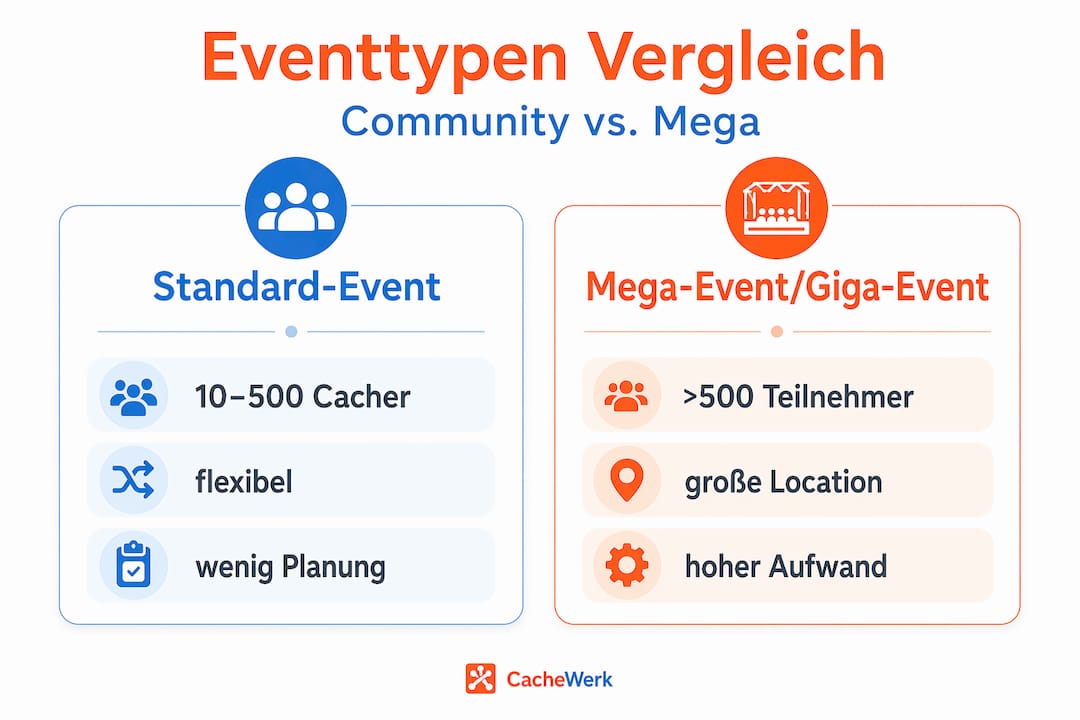
Anyone planning special event types in geocaching should know the requirements precisely. A mega-event requires months of lead time, while a flash mob can sometimes be created within a week.
An inspiring example of creative event design beyond geocaching is the motorcycle scavenger hunt, which shows how treasure hunting and community can be combined without relying on high-tech.
Pro-Tip: For your first mega-event as an organizer: get support from experienced event organizers in your region. No beginner can manage an event with 500 people alone. And they don't have to.
Success factors for cacher events: What participants truly value
After all the theory, the most important question is: What truly makes an event good for participants? The answer is surprisingly simple.
Participants value events with good food, geocache-rich environments, trackable trading, and thematic activities the most. These are not complicated requirements. But many organizers underestimate precisely these basics.
What distinguishes successful events:
- Hospitality from the start: A warm welcome lowers the barrier for newcomers.
- Structured schedule with open breaks: Too much program overwhelms, too little bores.
- Trackable station: A table for trading trackables always attracts a crowd.
- Geocaching excursion before or after the event: Joint caching nearby extends the experience.
- Small surprises: A self-made cache as a gift or a handmade souvenir remains memorable.
- Name tags with nicknames: One's own nickname on a tag makes the online identity tangible.
What many do not expect: getting to know the people behind the nicknames is the emotional highlight for many participants. You've known someone for years by a name like “TreasureHunter77,” and at the event, you shake their hand for the first time.
“The best thing about events isn't the log. It's the moment you see the person behind the nickname and realize: there's a real connection.”
Participant expectations for events can be summarized as follows: people want to feel a sense of belonging. If an organizer understands this, they can't create a bad event.
Another success factor often overlooked is the quality of nearby cache hides. If participants can find some special caches after the event, it rounds off the experience. This is where creatively designed hides come into play, leaving a lasting impression.
Perspective: Why Cacher Events are More Than Just Meetups
Here's an observation that is rarely articulated: Cacher events are one of the few places where a complete hobby unfolds its full potential.
Solo caching is great. The silence in the forest, the crunching underfoot, the moment the lid comes off. But events show what geocaching also is: a community with history, humor, and real cohesion. Those who only cache solo know only half of the hobby.
What we repeatedly hear from experienced geocachers and cache owners: Events are the strongest driver for creative cache design. When you see what other people build, when you listen to someone talk about a perfectly camouflaged hide, it sparks something. You go home with ideas you never would have had alone.
This is not theory. It's reflected in concrete numbers. The months after large events regularly show an increase in new caches in the region. Inspiration is contagious.
At the same time, we want to be honest: events are not for everyone. Those who are introverted and love the solitude of caching might feel uncomfortable at a large event. And that's perfectly fine. Small events with 15 to 20 people are often more accessible than mega-events with 500 participants. Start small.
An important piece of advice for organizers: set realistic expectations. Your first event doesn't need a perfect program. It just needs a reason why people want to come. A cozy location, a warm atmosphere, and a clear theme are enough.
Personal insights into cacher events repeatedly show: the most lasting memories are created not by perfect organization, but by genuine encounters. And that's exactly what no algorithm and no logbook can replace.
How to Perfect Your Cacher Events with the Right Equipment
Events are the perfect stage to try out new cache ideas and inspire the community. Whether you're an organizer looking to hide a special event cache or a participant wanting to bring creative trade items: the right equipment makes all the difference.
At CacheWerk Geocaching Equipment, you'll find exactly what you need for unforgettable events. From weatherproof hiding spots for outdoor event caches to personalized trackables that serve as souvenirs, and 3D-printed special hides made from PETG that will amaze participants. Particularly popular with event organizers are our urban camouflage solutions and small parts for creative hides, which you can present or raffle off directly at the event. Let our geocaching blog inspire you and bring ideas to your next event that will be remembered.
Frequently Asked Questions about Cacher Events
What exactly is a cacher event?
A cacher event is a gathering of geocachers whose main purpose is social interaction and exchanging ideas about geocaching, not finding a cache.
How do I register an event correctly?
Event Caches must be registered at least two weeks before the date and archived no later than four weeks after the event, otherwise you risk the listing being removed.
What distinguishes Maker Magic Events from normal events?
Maker Magic Events focus on cache quality and cache creation, last at least one hour, and take place annually during a special registration period.
What activities are popular at cacher events?
Participants most enjoy shared meals and trackable trading, followed by joint geocaching outings and thematic activities such as auctions or competitions.