
Geocaching Ranking Explained: How Leaderboards Work
Many geocachers believe there is a large global leaderboard listing the most diligent finders in the world. The reality is surprisingly different. Geocaching rankings exist in many different forms, from temporary campaign leaderboards to unofficial tools with their own criteria. Those who want to specifically optimize their adventures or, as a cache owner, collect more favorite points should understand how these systems really work. This article explains the different ranking forms, shows how points are collected, and provides practical tips for geocachers and owners.
Table of Contents
- What is a Geocaching Ranking?
- How Do Geocaching Leaderboards and Points Work?
- Informal Rankings: Tools and Regional Lists
- Why Rankings Motivate – and How They Influence Cache Owners
- Practice: Using Rankings Strategically for Adventures and Cache Strategy
- Caches for Ranking Success: Clever Solutions from CacheWerk
- Frequently Asked Questions about Geocaching Ranking
Key Insights
| Point | Details |
|---|---|
| No Global Top Lists | Geocaching rankings are campaign-specific or via third-party providers, but never officially worldwide. |
| Actions Earn Points | Collect points through find logs, events, favorites, and special actions on leaderboards. |
| Motivation and Community | Rankings promote quality caches and strengthen the geocaching community. |
| Regional Rankings | Tools like Project-GC and Cacherstats show regional and informal top lists. |
| Use Practical Tips | Strategic use of rankings significantly improves adventures and cache strategies. |
What is a Geocaching Ranking?
The term “Geocaching Ranking” sounds unambiguous, but it isn't. Depending on who you ask, someone might mean the leaderboards on Geocaching.com, a regional top list, or the statistics of a third-party tool. This often leads to confusion, especially for beginners.
The official ranking on Geocaching.com primarily refers to campaign-specific leaderboards that track temporary challenges. These leaderboards run for a specific period and measure who has collected the most points within that campaign. After the campaign ends, everything starts over.
What many don't know: there are no official global top-finder lists on Geocaching.com. A single worldwide leaderboard based on total finds does not exist there. This is partly due to the fact that geocaching is extremely versatile.
Overview of the most important ranking forms:
- Official Leaderboards on Geocaching.com for ongoing campaigns
- Regional Lists in community forums or local groups
- Tool-based Rankings via third-party providers like Project-GC
- Personal Statistics in profiles and apps
“A ranking always only says something about a specific aspect of the game, never about the geocacher as a whole.”
Different play styles make direct comparison difficult. Someone who exclusively searches for nature caches in remote mountain regions will naturally have fewer finds than someone who logs dozens of urban nano-caches daily. Both play geocaching, but their numbers are hardly comparable.
How Do Geocaching Leaderboards and Points Work?
The official leaderboards on Geocaching.com work according to a clear point system. Different actions earn different numbers of points, often referred to as "pages" in campaign language.

Here is an overview of the current point mechanics:
| Action | Points (Pages) |
|---|---|
| Find log of a cache | 1 |
| Participation in an event | 3 |
| Visit an Adventure Lab location | 1 |
| Receive a Favorite Point on your own cache | 3 |
| Collect a Treasure | 5 |
These different actions generate points, with events and treasures being particularly valuable. Those who specifically aim for a good leaderboard result should be aware of this weighting.
This is how a typical leaderboard is structured:
- Individual Ranking: Your personal progress within the campaign
- Community Progress: How close the entire geocaching community is to reaching the common goal
- Time Display: How many days the campaign still runs
- Rewards: Which badges or prizes are available at certain milestones
An important point: Leaderboards are always time-limited. A campaign typically runs for a few weeks or months. After that, points are reset and a new challenge begins. This makes rankings dynamic and gives everyone a new chance again and again.
Statistic: During active campaigns, hundreds of thousands of geocachers worldwide participate, making the leaderboards real community events.
Pro Tip: Plan your activities consciously around ongoing campaigns. Regularly check Geocaching.com for current leaderboard challenges and prioritize high-scoring actions, such as events or collecting treasures, if you are actively participating in a campaign.
Informal Rankings: Tools and Regional Lists
In addition to the official leaderboards, there is a vibrant world of unofficial rankings. These are created by the community and third-party providers and show completely different aspects of the game.
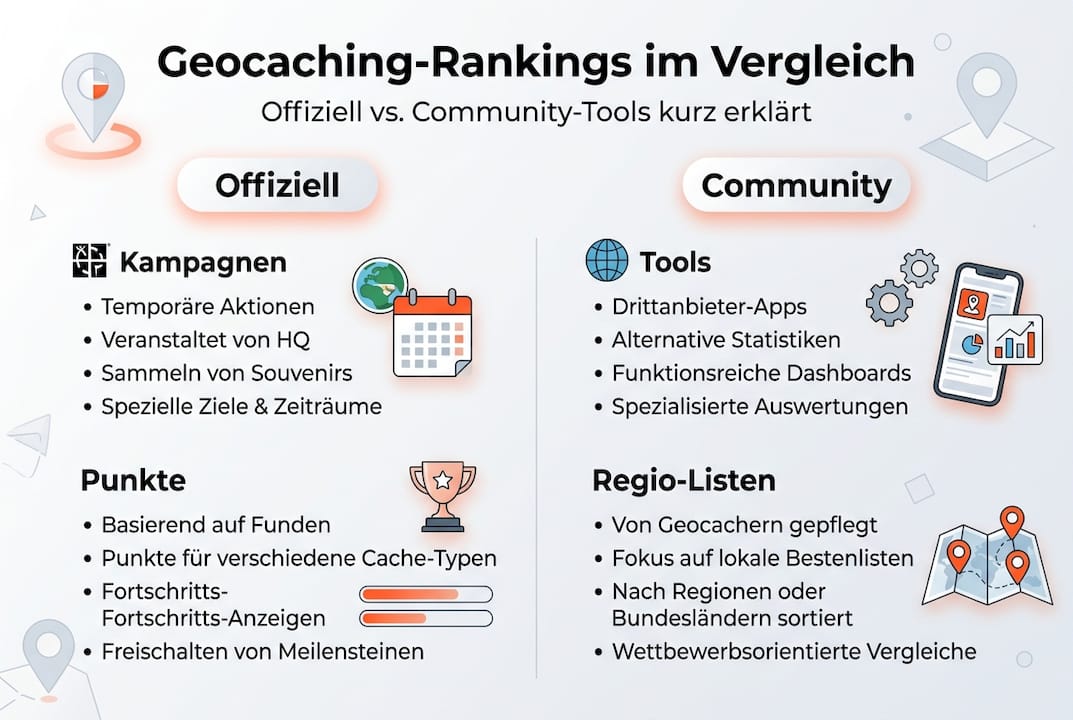
The best-known tools for informal rankings are Project-GC, Cacherstats.com and MyGeocachingProfile.com. They rank geocachers according to criteria such as total finds, countries visited, cache types solved, or the so-called D/T matrix.
What these tools display:
- Total Finds: Who has found the most caches?
- Country Ranking: In how many countries have caches been logged?
- Matrix Finder: Who has found all combinations of difficulty and terrain?
- Streak Lists: Who has the longest daily finding streak?
- Top Cachers by Region: Who leads in a specific country or federal state?
| Criterion | Official Leaderboards | Informal Tools || |—|—|—| | Period | Campaign-specific | Permanent | | Comparability | Within the campaign | Global or regional | | Update | Real-time | Daily or weekly | | Focus | Actions and events | Finds, matrix, countries |
A fascinating example of the dimension of informal rankings: In Austria, there are geocachers with over 100,000 total finds. These numbers are accumulated over many years of active playing and show how deeply geocaching can be rooted as a hobby. You'll only find such numbers in unofficial tools, not on Geocaching.com itself.
Pro Tip: Use Project-GC to analyze your personal D/T matrix. The tool shows you exactly which difficulty and terrain combinations you are still missing. This way, you can specifically search for caches that complete your matrix and explore new regions at the same time.
An important note: Informal rankings are not always directly comparable. Someone with 50,000 finds in a densely populated region has different opportunities than someone in a rural area. The numbers say a lot about activity, but little about the quality of the experiences.
Why Rankings Motivate – and How They Influence Cache Owners
Rankings have a strong psychological effect. They give geocachers a clear goal and make progress visible. For many, this is an important motivational factor that regularly sends them on the hunt.
For cache owners, the Favorite Point (FavPoint) is particularly relevant. Every finder can give a cache a Favorite Point if they particularly like it. These points are a kind of quality rating and are included in various rankings and statistics. Official leaderboards motivate quality caches with many FavPoints, with the focus on community progress rather than individual top lists.
How rankings influence owner behavior:
- More Creative Hides: Owners invest more time in design to receive FavPoints
- Better Maintenance: Well-rated caches are maintained more frequently
- Location Choice: Owners look for special places that delight finders
- Community Engagement: Owners react more actively to logs and feedback
But there are also critical voices. Some see statistics as fun, others as meaningless because they are incomparable and sometimes promote unnatural strategies, such as mass logging of Lab Caches just for points.
“Rankings can enrich or distort the game, depending on how you use them.”
The truth lies somewhere in the middle. Those who use rankings as personal motivation and do not forget the fun of the game will benefit from them. Those who only optimize for numbers often lose sight of the essentials. As an owner, you will find many practical tips on how to design caches that truly inspire in the Tips for Cache Owners.
Practice: Using Rankings Strategically for Adventures and Cache Strategy
Now, let's get specific. How can you strategically incorporate rankings into your geocaching strategy without letting numbers stress you out?
How to use rankings strategically:
- Follow Current Campaigns: Regularly check Geocaching.com for ongoing leaderboard challenges and plan your activities accordingly.
- Prioritize High-Quality Actions: Events and Treasures yield more points than simple finds. Actively plan events in your region.
- Analyze Your Matrix with Project-GC: Find out which D/T combinations you are missing and specifically search for them.
- As an Owner, Actively Encourage FavPoints: Design caches so creatively and with such high quality that finders automatically want to favorite them.
- Use Regional Rankings: Compare yourself with geocachers in your region, not globally. This is more realistic and motivating.
Official leaderboards are campaign-specific and time-limited, while permanent rankings via tools like Project-GC can be used for challenges and matrix optimization. This is an important distinction for your strategy.
What to pay attention to when collecting points:
- Quality over quantity: A well-planned cache outing brings more joy than hastily working through lists
- Don't forget the social component: Events bring points and new acquaintances
- Set your own goals: Define what you want to achieve with a ranking before you start
Pro Tip: As a Cache Owner, sustainable cache design is more valuable in the long run than short-term ranking optimization. A cache that collects FavPoints and delights finders for years brings you more than ten quickly placed nano-containers. Inform yourself about your duties and tasks in geocaching to be successful in the long term.
Caches for Ranking Success: Clever Solutions from CacheWerk
If you, as an owner, want to collect more FavPoints and inspire your community, it all starts with the right hide. A creative, well-camouflaged cache provides real "aha!" moments for finders and significantly increases the chance of favorite points.
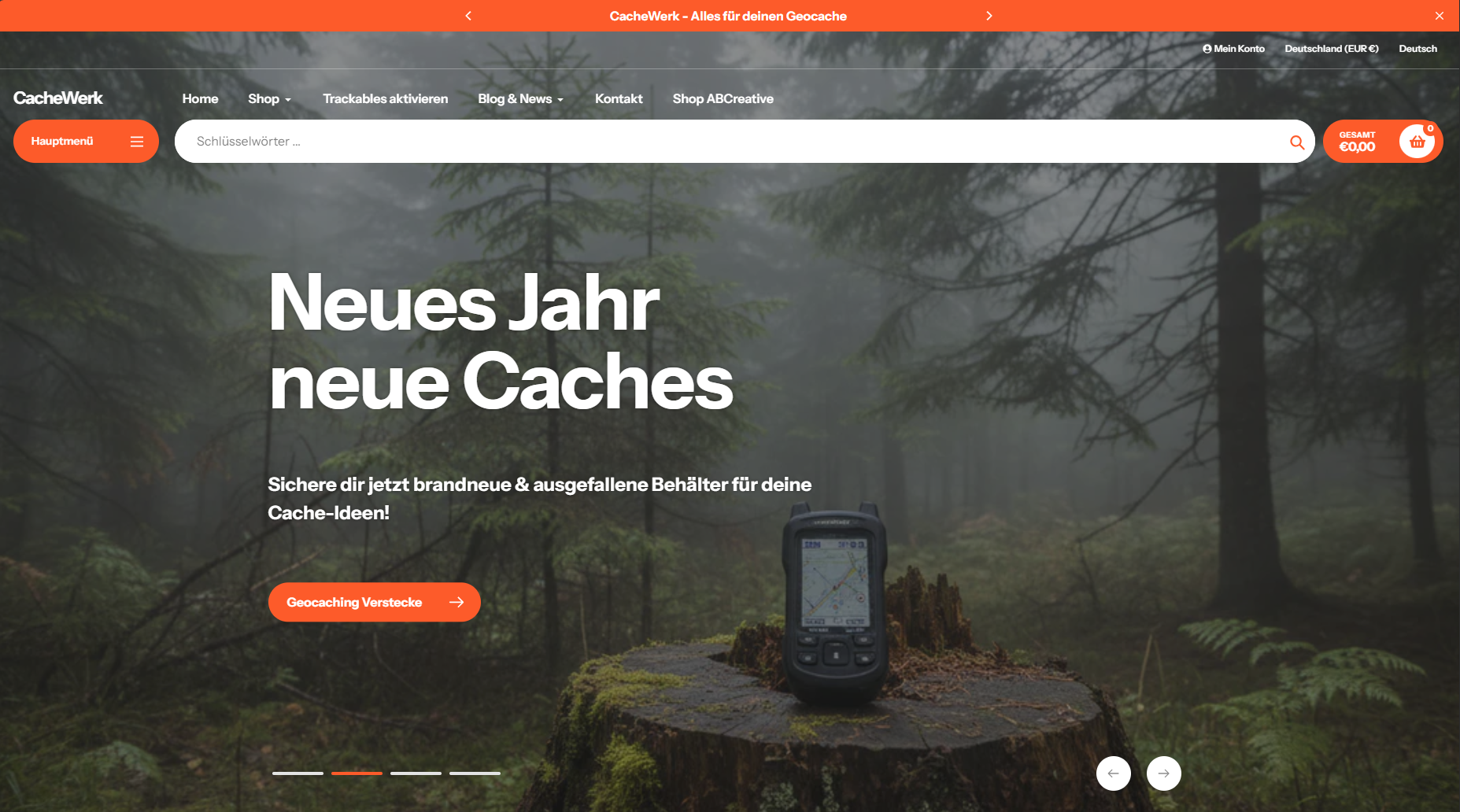
At CacheWerk, you'll find exactly what you need. Our camouflaged tree fungus hides are a perfect example: they look deceptively real, are weather-resistant, and create genuine surprise moments in the forest. Finders love such caches and are happy to give FavPoints for them. In addition to unusual hides, we also offer the right geocaching accessories for every application, whether urban or off-road. Invest in quality and your ranking results will follow.
Frequently Asked Questions about Geocaching Ranking
What counts as a point or page in Geocaching Ranking?
A find log counts as 1 page, an event visit as 3, an Adventure Lab location as 1, and a Favorite Point on your own cache as 3 pages. Treasures even give 5 points each.
Is there a global Geocaching Ranking?
No, Geocaching.com does not maintain global top lists. There are only campaign-specific leaderboards and many unofficial tools with their own criteria and lists.
How do rankings influence the behavior of cache owners?
Rankings motivate owners to create high-quality caches and actively promote community engagement, as Favorite Points can directly contribute to campaign points.
Which tools are available for informal Geocaching Rankings?
Among the most well-known tools are Project-GC, Cacherstats.com, and MyGeocachingProfile.com, which rank by finds, countries, matrix, and other criteria.