Geocachers: Coating and Assembly to Make Hides Last Outdoors

For consistently damp or salty hiding spots, opt for epoxy or PTFE, not Ni-Cu-Ni. The latter often only lasts 48 to 72 hours in salt spray tests before corrosion begins. For high impact stress, such as on nano-caches with high foot traffic, a rubber-coated solution outperforms both. And no matter which coating you choose: a well-designed encapsulation often protects more than the coating itself.
In short:
- Ni-Cu-Ni magnets only last about 48 to 72 hours in salt spray tests, making them only conditionally suitable for coastal areas.
- Epoxy coatings offer longer corrosion protection of over 500 hours but are more brittle and susceptible to impact.
- PTFE is highly abrasion-resistant and water-repellent, but it is difficult to bond, which complicates assembly.
- For permanently damp or salty locations, a combination of coating and encapsulation is recommended, such as epoxy or stainless steel housing.
- For locations with high foot traffic, a rubber-coated solution protects against damage and increases impact resistance.
Table of Contents
- Magnet Coating for Outdoor Use: An Overview of the Most Important Materials
- Which Coating is Right for Which Outdoor Situation?
- How to Protect Magnets During Outdoor Installation
- How to Build Weatherproof Magnetic Hides
- What Really Matters When Building an Outdoor Magnetic Hide
- Ready-Made Solutions Instead of Trial-and-Error for Magnetic Hides
- Sources
Magnet Coating for Outdoor Use: An Overview of the Most Important Materials
Six types of coatings consistently appear in geocaching forums and manufacturer catalogs. Each functions differently, and none is equally suitable for every location.
Ni-Cu-Ni (Nickel-Copper-Nickel) is the standard coating for most commercially available neodymium magnets. It consists of three electroplated layers with a total thickness of a few micrometers and provides a smooth, conductive covering. For dry indoor environments, this is perfectly adequate. Outdoors, it's a different story: Ni-Cu-Ni typically lasts only 48 to 72 hours in a salt spray test before the first signs of corrosion appear.
Epoxy is applied much thicker, usually in the range of several tenths of a millimeter, and forms a chemically stable barrier. According to manufacturers, epoxy can withstand over 500 hours in salt spray tests in some cases, sometimes significantly longer than pure nickel. The disadvantage: epoxy is more brittle and sensitive to impacts and scratches.
PTFE (Teflon) boasts a nearly water-repellent, chemically inert surface and high abrasion resistance. Bemagnet describes PTFE as one of the most durable options against moisture and mechanical stress, but at a significantly higher price. A disadvantage for hobbyists: the smooth, inert surface is difficult to bond, which can be a problem when mounting in housings.
Parylene is applied in a vacuum process as an extremely thin, gapless film and penetrates even the finest crevices. This makes it the preferred choice when a second protective layer is applied over Ni-Cu-Ni.
Zinc is inexpensive and widely used, but offers only moderate corrosion protection and is rarely recommended for permanent outdoor use.
Rubber-coated magnets completely encapsulate the core in an elastic sheath. They lose some adhesive force but gain massive impact resistance.
A practical rule of thumb: a multi-layer solution, such as Ni-Cu-Ni as a base layer plus an additional epoxy or parylene seal, is always worthwhile when a magnet is permanently installed outdoors and is not protected by a housing.
Random Fact: Ni-Cu-Ni magnets barely last three days in salt spray tests. If you hide your cache near the coast, you shouldn't ignore this number.
Which Coating is Right for Which Outdoor Situation?
Not every cache location has the same requirements. A covered cavity under a park bench demands something different than a magnet constantly exposed to standing rainwater.
- Covered, dry areas (garages, shelters, interiors of objects): Ni-Cu-Ni is usually perfectly sufficient here.
- Open locations with occasional rain: Epoxy or a Ni-Cu-Ni base with parylene sealing are the safer choice.
- Standing fresh water (puddles, ditches, damp forest floors): Epoxy shows clear advantages over pure metal coating here.
- Near saltwater (coastal paths, harbor facilities, bridges over tidal waters): PTFE or epoxy are mandatory; Ni-Cu-Ni is practically out of the question here.
- High foot traffic with frequent handling or vandalism risk: Rubber-coated magnets absorb impact energy and protect the underlying coating from cracks.
- Direct sunlight on metal surfaces (canal bridges, metal fences in summer): Here, the temperature limit of the magnet material is crucial, not just the coating.
Temperature is an often underestimated factor. Neodymium magnets lose field strength with sustained heat, and some coatings like epoxy can chemically degrade at high temperatures. A magnet exposed to direct sunlight for hours on a metal surface can easily reach 60 to 80 degrees Celsius, depending on the substrate and color. For some N35 grades, this is already enough to noticeably lose adhesive force.
Pro Tip: Check the cache location at different times of day. A magnet that is in the shade in the morning may be directly in the sun at noon. This significantly changes the requirements for coating and magnet quality.
For the underside of a park bench, Ni-Cu-Ni with stable encapsulation is usually sufficient. A canal bridge with constant moisture requires epoxy. And a riverside area with brackish water or spray should only be equipped with PTFE or a robust epoxy solution.
How to Protect Magnets During Outdoor Installation
Even the best magnet coating is of little use if scratches occur during installation. This is where most damage happens, often unnoticed.
- Clean and degrease the surface before gluing. Residues of fingerprints or dust prevent a durable bond.
- Never let magnets snap together hard. The jolt when they snap together can cause microscopic cracks in epoxy or parylene, where corrosion later begins invisibly from within.
- Choose the right adhesive. This becomes difficult with PTFE-coated magnets, as the surface is chemically inert. Here, a contact adhesive with pre-activation or a mechanical clamping solution helps instead of pure bonding.
- Plan for encapsulation. A PETG housing, a small stainless steel housing, or a PVC pot housing takes the direct weather load off the magnet.
- Seal joints additionally. Silicone or a second epoxy layer at the transitions prevents water from penetrating through small gaps.
- Check regularly. Every few months, a quick check for greenish or reddish discolorations is worthwhile, as these are the first visible signs of incipient corrosion.
Pro Tip: Small green dots on the magnet surface are usually copper corrosion caused by a scratch in the Ni-Cu-Ni layer. If you detect this early, resealing with clear epoxy lacquer is often enough to stop further degradation.
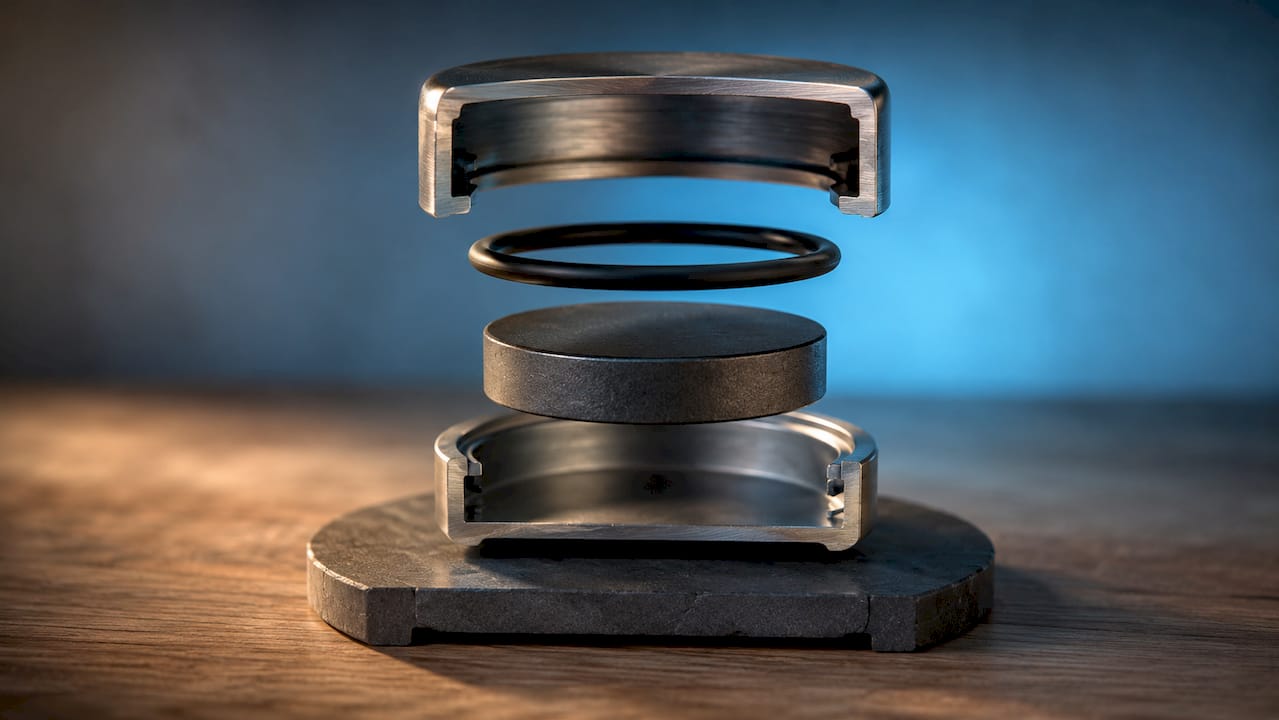
A pot housing is often more effective than any coating alone. It absorbs mechanical shocks, keeps water out, and can be replaced if necessary without damaging the magnet itself.
How to Build Weatherproof Magnetic Hides
When constructing its own hides, Cachewerk relies on combinations that implement precisely these principles. The PETling with magnet holder uses mechanical decoupling between the magnet and the container, so the coating itself has almost no contact with rough edges even when frequently opened. With the screw hide with a secret compartment, the magnet is protected inside the threaded head, shielded from direct weather influences. The stainless steel cap nut combines a waterproof metal housing with an additional inner encapsulation, ideal for damp or urban locations with high foot traffic.
- PETling: lightweight construction, replaceable magnet holder, good for dry to moderately damp locations
- Screw hide: robust camouflage in an everyday object, magnet protected in the thread
- Cap nut nano: waterproof stainless steel housing, suitable for coastal and riverside locations
Detailed building instructions can be found in the Magnet Building Workflow.
What Really Matters When Building an Outdoor Magnetic Hide
When I see how many caches lose their magnetic force after two rainy periods, it's almost never due to a fundamentally wrong magnet choice. It's about the order of priorities. The coating comes first, but it's only half the battle. The assembly determines whether this coating even has a chance, and maintenance determines how long it will last. Anyone who tackles these three steps in the right order, instead of just looking for the strongest magnet, builds hides that will last for years. For your first magnetic cache: start with an encapsulated product, not a bare magnet that you glue yourself. The learning curve is drastically reduced.
— Benedikt
Ready-Made Solutions Instead of Trial-and-Error for Magnetic Hides
Anyone who works through coating types, adhesives, and encapsulation variants quickly invests several crafting evenings before the first cache is even placed outdoors. Cachewerk takes this part off your hands: the hides are already designed, tested, and ready for use with the appropriate magnet solution for their intended purpose.
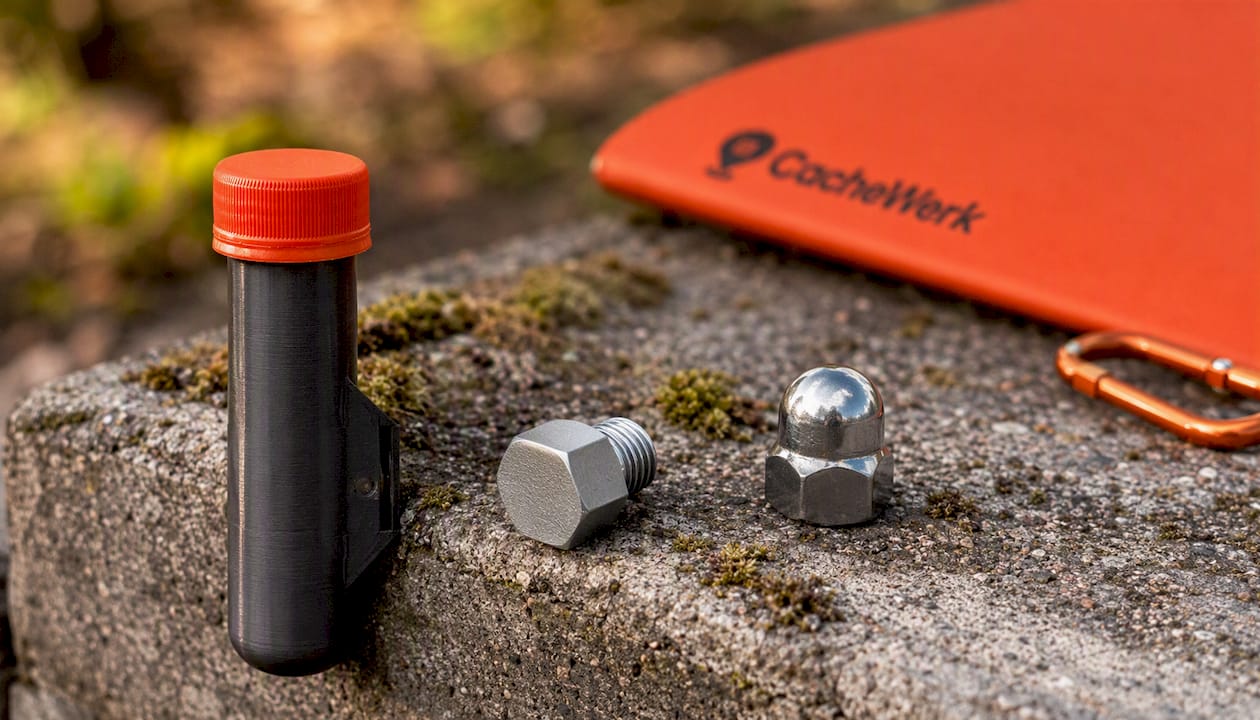
The PETling with magnet holder is suitable for quick, inconspicuous hides in urban environments. The screw hide with a secret compartment camouflages itself as an everyday object and protects the magnet inside. For damp or coastal locations, the stainless steel cap nut provides the most waterproof solution in the range. All three products are developed in-house by Cachewerk. Visit the shop, compare the variants, and order the right hide for your next cache location.
Sources
Technical backgrounds are provided by HSmagnet, Bemagnet and Supermagnete. Salt spray test values and temperature limits are worth a closer look before purchasing.
- How to choose the right coating for your magnets: Nickel-Copper-Nickel vs. Epoxy vs. Parylene
- Supermagnete