
Multicaches in Geocaching: Structure, Tips, and Ideas
Not all geocaches are structured the same way. Anyone who thinks every cache is just a container with a logbook hasn't experienced multicaches yet. This special cache type, according to estimates, makes up only 5 to 8 percent of all active geocaches, but offers disproportionately high enjoyment. Multicaches guide you step by step through multiple stages, each with a new clue. The result is a real adventure, not a simple container hunt. In this article, we explain how multicaches are structured, what variations exist, how to implement creative ideas, and what mistakes you, as an owner, should absolutely avoid.
Table of Contents
- Basics and Structure of Multicaches
- Variations and Special Features of Multicaches
- Creative Ideas for Multicaches: Urban and Rural
- Common Mistakes and Pro Tips for Multicache Owners
- My Perspective: Why Multicaches are Often Underestimated
- Further Geocaching Accessories for Creative Multicaches
- Frequently Asked Questions about Multicaches
Key Takeaways
| Point | Details |
|---|---|
| Versatile Structure | Multicaches consist of several successive or branching stages and offer variety in the search. |
| Creativity Required | Especially with multicaches, unusual puzzles and creative ideas can significantly enhance the geocaching experience. |
| Robust Planning Needed | A failure of individual stages can cripple the entire multi – smart preparation is therefore essential. |
| Ideal for City and Country | Multicaches can be flexibly integrated into various environments and add an exciting touch to the location and story. |
Basics and Structure of Multicaches
A multicache is a type of cache where you don't navigate directly to the final. Instead, you visit several stages, also called waypoints, one after another. Each stage contains a clue or a coordinate that leads you to the next stage. Only the last stage contains the actual logbook. This sounds simple but can become very complex depending on the owner's planning.
Thousands of multicaches exist worldwide since 2000, when geocaching emerged as a hobby. The popularity of this cache type lies primarily in the fact that it truly guides seekers through an area and not just to a single point. You get to know places you would otherwise never have noticed.
Typical structures for multicaches:
- Linear Multicache: You go from stage to stage in a fixed order. No shortcuts possible.
- Offset Multi: The starting coordinates lead to an information point, from which you calculate the actual coordinates.
- Branching Multicache: At certain points, you have a choice between different paths, all leading to the final.
- Freely selectable order: You can visit the stages in any order and collect parts of the final coordinate.
The difference to a Traditional Cache is obvious: With a Traditional, you find the logbook directly at the given coordinates. With a Mystery Cache, you solve a puzzle in advance to calculate the final coordinates. With a Multicache, however, you must be physically on site and visit each stage. This makes it more time-consuming, but also significantly more adventurous. You can find more about the differences to other cache types in our blog.
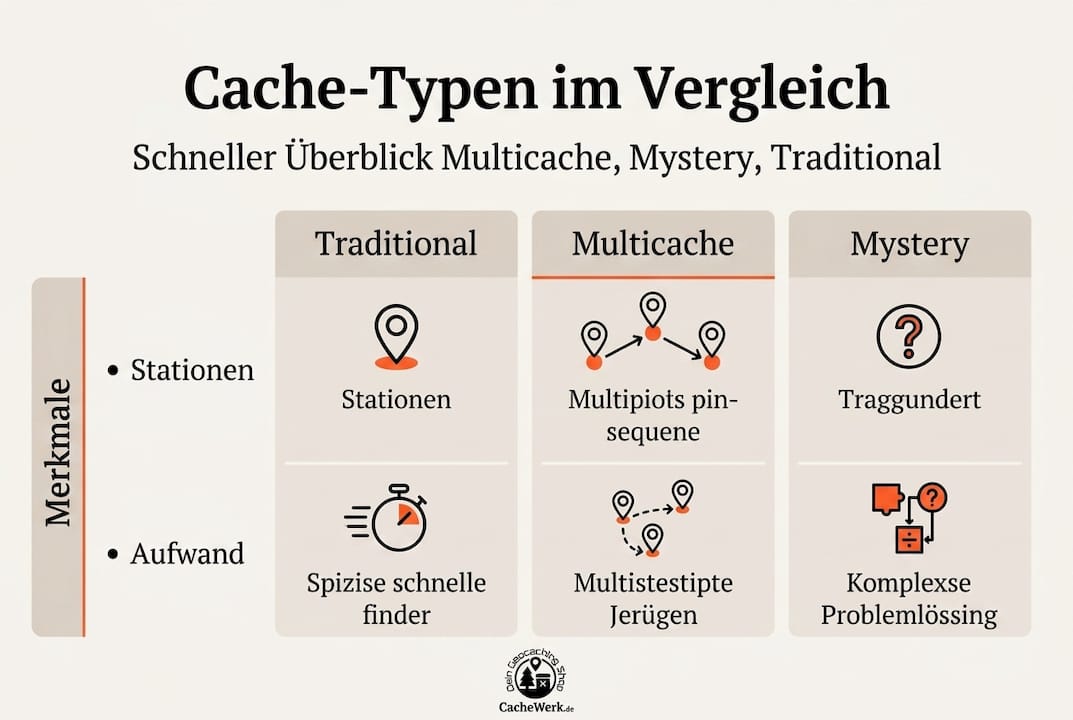
| Feature | Traditional Cache | Mystery Cache | Multicache |
|---|---|---|---|
| Stages | 1 | 1 (after puzzle) | 2 or more |
| Pre-puzzle required | No | Yes | No |
| Physical Waypoints | No | No | Yes |
| Time commitment | Low | Medium | High |
| Experience factor | Medium | High | Very high |
The table clearly shows: Multicaches are hard to beat in terms of experience factor. If you really want to immerse yourself in a story or a landscape, this is the right place.
Variations and Special Features of Multicaches
Now that the structure is clear, let's look at the many variations and their special features. Not all multicaches work on the same principle. The differences are sometimes considerable and influence how you as an owner plan and how seekers experience the tour.
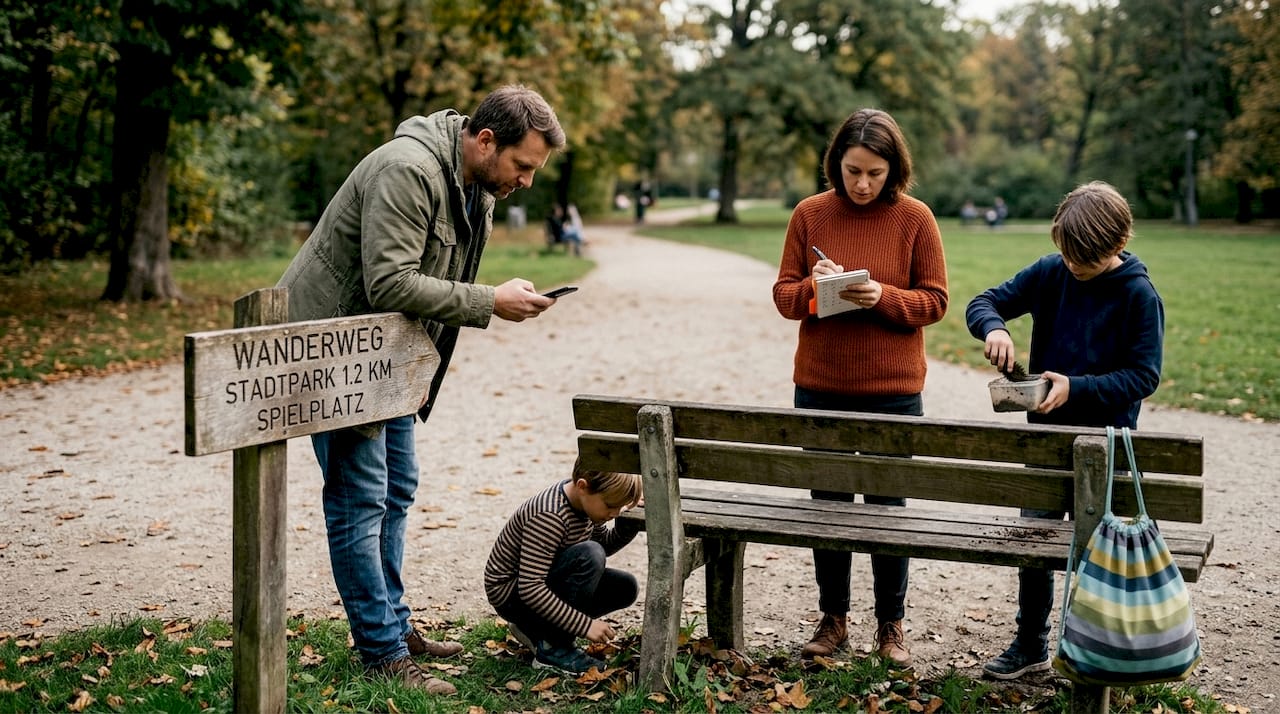
Linear versus branching multicache in comparison:
| Criterion | Linear Multi | Branching Multi |
|---|---|---|
| Planning effort | Medium | High |
| Error susceptibility | High (one stage fails) | Lower (alternative routes) |
| Variety of experience | Uniform | Varied |
| Suitable for | Beginner Owners | Experienced Owners |
A particularly clever variation is the so-called Herford Method. Here, the cache completely bypasses physical intermediate stages. Instead, information from the surroundings is used, for example, years on buildings, house numbers, or inscriptions on monuments. This significantly reduces maintenance effort and simultaneously makes the cache more robust against vandalism.
Offset multis are another popular form. Here, the starting coordinates lead to an information point, usually a sign, a monument, or a plaque. From the information visible there, you calculate the coordinates of the next stage or the final. This method is particularly elegant because no physical container is needed at the first stage.
How to plan a robust multicache:
- Choose stages that are difficult to damage or steal.
- Where possible, use natural information sources instead of physical containers.
- Always plan a backup clue for emergencies.
- Test the cache multiple times before publishing.
- Keep the coordinates of all stages in your records.
The biggest risk with sequential multicaches is the failure of a single stage. If stage 3 of 5 is missing or damaged, seekers cannot proceed. This is frustrating and leads to negative logs. Branching structures or the Herford method offer clear advantages here.
Pro tip: For physical stages, use only weatherproof materials. Stainless steel magnetic containers, waterproof nano-containers, or special PETG-printed housings last significantly longer than simple plastic boxes. This saves you a lot of maintenance effort in the long run.
Those interested in creative multicache implementations in cities will find many more ideas for getting started there.
Creative Ideas for Multicaches: Urban and Rural
Now that you know the variations, let's look at creative application possibilities for different environments. Whether big city or forest path, multicaches can be excitingly designed anywhere. The key lies in cleverly using the environment.
Ideas for urban multicaches:
- QR codes as stages: Inconspicuous stickers on lampposts or benches lead seekers to the next coordinate. Completely invisible to Muggles (non-initiates).
- Electrical puzzles: A small LED circuit in a magnetic container outputs the next coordinate via Morse code. Tech enthusiasts love this.
- Artworks and graffiti: Certain letters or numbers in a mural encode the next stage. Creative and inconspicuous.
- House numbers and street signs: Classic but effective. Seekers must actively perceive their surroundings.
- Public clocks or fountains: Certain features provide numerical values for calculation.
Multicaches are particularly popular in Europe for historical tours and city walks. This makes them a perfect tool to bring history to life.
„A good multicache is like a self-guided city tour. You get to know places you would otherwise never have noticed, and all on your own."
Ideas for rural multicaches:
- Use historical boundary stones or old signposts as sources of information.
- Incorporate tree species or rock formations as puzzle bases.
- Weave local legends or stories into the stages.
- Plan viewpoints as a reward between stages.
- Use natural phenomena like tree hollows or rock formations as hiding places.
Pro tip: When choosing materials for rural stages, pay attention to true camouflage. Bark-patterned containers, colored stone replicas, or PETG-printed tree stumps blend perfectly into nature and withstand wind and weather. Further tips for urban multicaches will help you get the most out of your urban cache.
Common Mistakes and Pro Tips for Multicache Owners
With creative ideas in mind, it's important to know typical mistakes and proven methods. Many owners start motivated, but make avoidable errors that quickly render the cache unsolvable.
The 5 most common mistakes with multicaches:
- Too fragile stages: Small plastic boxes without seals won't survive a winter. Invest in waterproof containers.
- Missing backup solutions: If a stage disappears, the cache is dead. Always plan an alternative solution or include clues in the listing.
- Too little communication with seekers: Many owners don't respond to help requests. A friendly hint via message often saves the experience.
- Poor coordinate accuracy: Inaccurate GPS data misleads seekers. Measure multiple times and at different times of day.
- Neglected maintenance: A cache without regular checks quickly becomes a problem. Plan fixed maintenance intervals.
The risk of a stage failing is particularly high with sequential multicaches. If stage 2 of 4 fails, seekers cannot proceed, and the entire cache becomes unplayable. Solutions include, for example: leaving a clue in the listing to help in an emergency, or replacing the stage with a more robust variant.
Maintenance tips for long-lasting multicaches:
- Visit all stages at least once per quarter.
- Check all exposed stages after heavy rain or storms.
- Respond to Needs-Maintenance logs within 48 hours.
- Replace logbooks before they are full.
- Document all stages with photos for quick repairs.
Pro tip: Set a calendar reminder to check your multicache every 8 weeks. Owners who maintain regularly receive significantly better ratings and fewer problem reports. This pays off in the long run. More ideas for designing creative caches will help you plan your next multicache even better.
My Perspective: Why Multicaches are Often Underestimated
Multicaches rarely stand in the spotlight. Traditionals are quicker to find, Mystery Caches are considered intellectually demanding. But multicaches? They often fall through the cracks. This is a shame, because they demand the most from the owner: creativity in stage planning, technical knowledge in implementation, and genuine perseverance in maintenance.
The high maintenance effort deters many. We understand that. But it is precisely this effort that makes multicaches so special. Anyone who places a well-maintained multicache with five thoughtful stages leaves a lasting impression on the community. Seekers remember such caches for years.
Our appeal: Dare to lay more complex multicaches. Use creative design ideas and actively share your experiences within the community. Innovative multicaches deserve more visibility. They are the best argument that geocaching is much more than a GPS game.
Further Geocaching Accessories for Creative Multicaches
If you want to take your next multicache to a new level, you need the right equipment. Weatherproof magnetic containers, camouflaged nano-containers, 3D-printed PETG hideouts, or special puzzle technology make the difference between an average and an unforgettable cache.
At cachewerk.de, you'll find exactly what you need: from robust containers for rural stages to inconspicuous urban hideouts. Our product range is specially tailored to the requirements of multicache owners. Check out our geocaching equipment and accessories and combine your creative ideas with the right materials. Your next multicache will delight seekers.
Frequently Asked Questions about Multicaches
How many stages does a typical multicache have?
The number varies greatly, usually between 2 and 6 stages, rarely more than ten. Anything over three stages is already considered challenging.
What distinguishes multicaches from mystery caches?
Multicaches require visiting actual stages, while Mystery Caches often present a puzzle to calculate the final in advance. With a Mystery, you theoretically stay at your desk; with a Multi, you are definitely out and about.
How risky is the failure of a stage in multicaches?
If a stage fails, the entire cache is often unsolvable. Robust planning, regular maintenance, and backup clues in the listing are therefore indispensable.
Are multicaches more suitable for cities or rural areas?
Both environments are possible. Urban multis rely on technology, puzzles, and urban camouflage, while rural multis thrive on history and nature. The choice depends on your creativity and the available terrain.