
Extremely Robust Geocaches: The Best Containers & DIY
TL;DR:
- High-quality materials such as HDPE and polypropylene ensure durable geocache containers.
- Standard containers like PETlings and ammo cans are proven solutions for various environments.
- High-priced high-end containers are suitable for extreme conditions, while DIY solutions are often just as durable.
Many cache containers fail after just one season. Moisture creeps through poorly fitting lids, frost breaks seals, and clumsy finders bend clasps. The result: soaked logbooks, frustrated seekers, and a cache that needs maintenance or abandonment. Anyone planning a geocache for the long term needs more than a randomly chosen plastic container. This article shows you which criteria really matter, which standard containers prove themselves over years, where high-end solutions have their place, and which DIY ideas deliver real surprises. You'll also get a direct comparison of all types to help you decide.
Table of Contents
- Important Criteria for Robustness and Durability in Geocache Containers
- Standard Containers: The Proven Types for Long-Term Geocaches
- High-End and Special Containers: Pelican Case, Mighty Mega, and More
- DIY Robust Solutions and Creative Cache Ideas
- Comparison Table: Pros and Cons of Robust Cache Containers
- Expert View: What Really Works – and What Fails
- Find Extremely Robust Geocache Hides and Accessories at CacheWerk Now
- Frequently Asked Questions about Robustness and Cache Construction
Key Takeaways
| Point | Details |
|---|---|
| Standard containers preferred | PETlings and ammo cans withstand weather best and are the basis of every cacher's list. |
| DIY can surprise | With slip couplings, epoxy adhesive, and creativity, waterproof DIY containers can be created for any situation. |
| Test before hiding | Immersion test or stress test are crucial to keep your cache safe for years. |
| High-end only for extreme needs | Pelican or Mighty Mega are worthwhile primarily in extreme conditions such as floods or frost. |
Important Criteria for Robustness and Durability in Geocache Containers
Before you buy or build a container, it's worth knowing the selection criteria. A container may look perfect optically but still leak after three months. The material, closure, seal, and ease of maintenance are crucial.
Material is the first factor. High-density polyethylene (HDPE) and polypropylene (PP) withstand frost, UV radiation, and moisture well. Metal is durable but can rust if the coating is damaged. Galvanized or anodized surfaces are clearly superior here.
The type of closure determines the tightness. Screw caps with internal threads are more reliable than external threads because water doesn't run into the thread grooves. Clip closures are practical but only tight if the rubber seal is intact.
Here are the most important selection criteria at a glance:
- Tightness: Is a rubber seal present and intact?
- Material thickness: Wall thickness at least 2 mm for outdoor use
- Closure type: Prefer screw cap, clip only with seal
- UV resistance: Important for exposed locations
- Maintainability: Can the seal be replaced?
- Camouflage: Color and shape adapted to the location
- Weight: Relevant for climbing tours or long approach routes
The Geocache Camouflage Tips also show you how to optically adapt containers to their surroundings without compromising tightness.
Pro tip: Test every container before placement with an immersion test. Put the lid on, immerse it in water for five minutes, then check the inside. What leaks in the bathroom won't survive autumn rain.
Robustness against the environment and clumsy cachers is essential. Fragile mechanics have no place in the field.
Maintainability is often underestimated. A cache you check once a year needs a container where you can easily replace seals. Complicated mechanisms sound exciting but fail precisely when you're not there.
Standard Containers: The Proven Types for Long-Term Geocaches
The geocaching community has identified clear favorites over the years. No coincidence: these containers impress with their simplicity, availability, and proven durability.
PETlings (PET tubes with screw caps) are a classic. They are lightweight, inexpensive, and last for many years with proper care. The internal thread protects against water ingress. For nano and micro caches, there is hardly a better solution.
Ammo cans are made of galvanized steel and equipped with a rubber seal. They withstand extreme conditions, are theft-proof, and have enough space for a proper logbook plus trade items. Ideal for regular and large caches in nature.
35ml screw-top plastic containers are compact and inconspicuous. Perfect for urban hides where size and camouflage are crucial. The creative camouflage of these small containers makes them real muggle traps.
Clip'n'Close containers are available in many sizes and are inexpensive. They work well as long as the seal remains intact. Regular checks are mandatory here.
According to a long-term test of various containers, PETlings, Clip'n'Close containers, 35ml screw-top containers, and ammo cans are among the most reliable options for outdoor use.
| Container Type | Size | Tightness | Price | Recommendation |
|—|—|—|—|—|
| PETling | Nano to Small | Very good | Inexpensive | Micro/Nano |
| Ammo Can | Regular to Large | Excellent | Medium | Nature/Forest |
| 35ml Screw-top Container | Nano | Good | Very inexpensive | Urban |
| Clip'n'Close | Small to Large | Good (with seal) | Inexpensive | General |
The Terrain Rating Tips will help you correctly assess the location. A terrain 5 cache requires different considerations than a simple forest path cache.
An important practical value: Ammo cans last over ten years in tests without seal replacement, if not mechanically damaged. That's hard to beat.
High-End and Special Containers: Pelican Case, Mighty Mega, and More
For caches in extreme locations, standard solutions are sometimes not enough. Flood zones, mountains with deep snow, or heavily frequented urban spots demand more. This is where high-end containers come into play.
Pelican Cases are made of impact-resistant polycarbonate and have an integrated pressure equalization valve. This prevents temperature fluctuations from pushing open the lid. They are IP67 waterproof, which means: up to one meter water depth for 30 minutes. A serious option for caches near streams or on riverbanks.
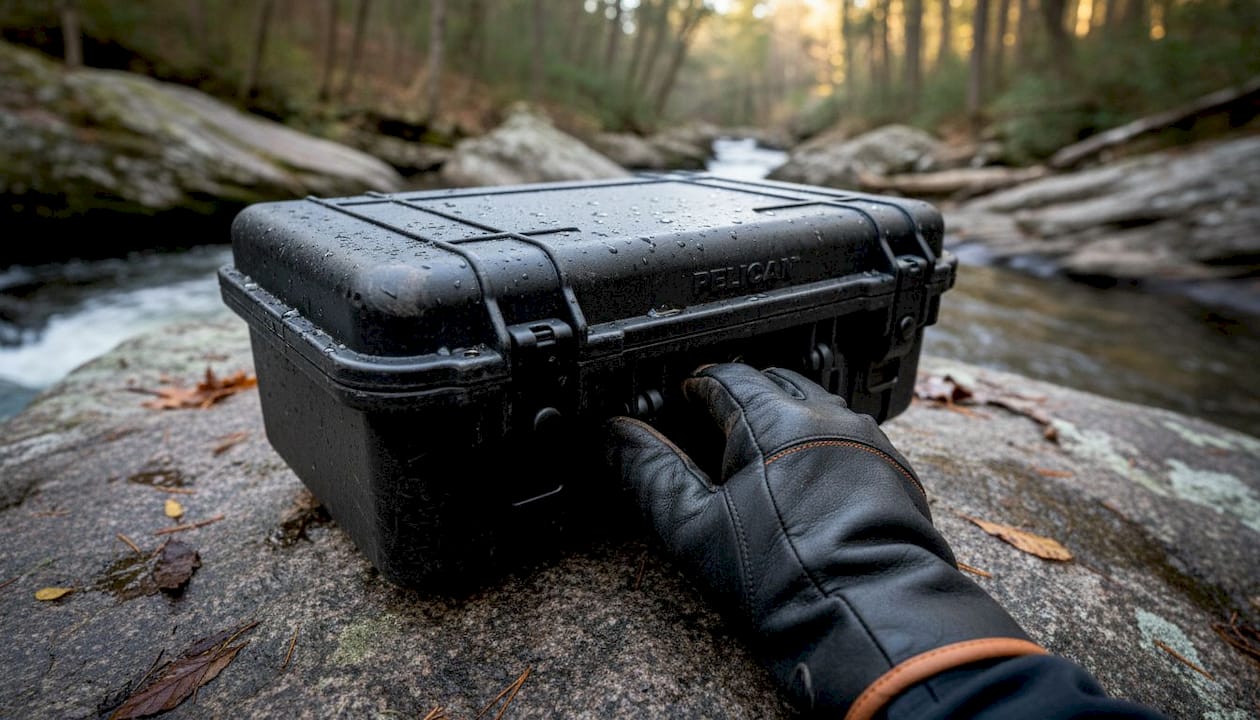
Mighty Mega Cache Containers are made of aluminum with massive wall thickness. They are heavy but virtually indestructible. No frost, no finder, and no lawnmower can damage these containers.
According to a test of high-end containers, Pelican Case and Mighty Mega Cache Containers are the most robust available options for extreme conditions.
Here are the advantages of high-end containers:
- Pressure equalization prevents vacuum effect when opening
- Impact resistance far beyond standard levels
- Long-term tightness even under mechanical stress
- Professional appearance increases respect among finders
The disadvantages are also clear. Pelican Cases cost many times more than a PETling. They are harder to camouflage and stand out in some locations. For a forest cache in a medium location, the price-performance ratio is poor.
Pro tip: Use high-end containers specifically for caches with a high terrain rating or in exposed locations. For standard forest hides, a good PETling is the smarter choice. The difficulty and terrain rating will help you choose the right container for your location.
| Criterion | Pelican Case | Mighty Mega | PETling |
|---|---|---|---|
| Water Resistance | IP67 | Very High | High |
| Impact Resistance | Very High | Extreme | Medium |
| Weight | Medium | Heavy | Light |
| Cost | High | High | Low |
| Camouflage | Difficult | Difficult | Easy |
DIY Robust Solutions and Creative Cache Ideas
Commercial solutions are good. But sometimes you want something that can't be bought anywhere. DIY containers offer maximum creativity and, if executed correctly, can be just as robust as finished products.
Here are the most proven DIY approaches:
- Slip coupling DN50 with stopper: A plastic coupling (diameter 50mm) is sealed with a rubber stopper and secured with epoxy adhesive. Material costs about 6 euros. Waterproof tested and ideal for buried caches.
- Pseudo birdhouse around PETling: A small wooden casing is built around a PETling. With wood glue and weatherproof paint, a muggle-proof hide is created that even observant passers-by won't notice.
- Magnetic PETling: Neodymium magnets are attached to the PETling with Patex Repair Extrem adhesive. The result is a strong adhesion to metal surfaces, ideal for urban hides under benches or on fences.
The most common mistakes with DIY containers:
- Internal and external threads incorrectly combined, allowing water to penetrate
- Seals made of unsuitable material that hardens in the cold
- Material mix of metal and plastic that expands and contracts with temperature fluctuations
- Adhesive that is not UV-resistant and fails after one summer
Pro tip: For all outdoor adhesive connections, only use UV-resistant epoxy adhesives or silicone. Normal superglue might last one winter, then it becomes brittle.
The camouflage instructions show you how to design DIY containers so that they blend completely into their surroundings.
A well-built DIY cache beats any expensive ready-made container if the location and camouflage are right. The difference lies in the care taken during construction, not in the price.
Comparison Table: Pros and Cons of Robust Cache Containers
Now you've learned about all the types. Here's a direct comparison for your final decision.
| Container Type | Durability | Tightness | Maintenance | Cost | Camouflage |
|---|---|---|---|---|---|
| PETling | Very High | Very Good | Minimal | Low | Easy |
| Ammo Can | Extremely High | Excellent | Low | Medium | Difficult |
| 35ml Screw-top Container | High | Good | Minimal | Very Low | Easy |
| Clip'n'Close | Medium to High | Good | Regular | Low | Medium |
| Pelican Case | Extremely High | IP67 | Low | Very High | Difficult |
| Mighty Mega | Extremely High | Very High | Minimal | Very High | Difficult |
| Slip Coupling | High | Very Good | Low | Very Low | Good |
| Pseudo Birdhouse | Medium | Good (PETling) | Medium | Low | Excellent |
An important note on the table: ALCON and Nacro containers appear robust, but are not rainproof with a loose lid. Those who rely on these types must regularly check the lid's fit.
Brief conclusions per type:
- PETling: First choice for Micro and Small. Proven, inexpensive, low maintenance.
- Ammo Can: Best choice for Regular and Large in nature. Unbeatably robust.
- Pelican Case: For extreme locations with a high terrain rating.
- Slip Coupling: Best price-performance ratio in the DIY sector.
- Pseudo Birdhouse: When camouflage is more important than anything else.
Expert View: What Really Works – and What Fails
After years in the community and many reports from owner experiences, a clear pattern emerges. The caches that last the longest are rarely the most technically elaborate. They are the best placed and most carefully tested.
According to empirical data from long-term tests, simple standard containers often outperform elaborate constructions in terms of durability. The reason is simple: Less mechanics means fewer sources of error.
The biggest problem in practice is not the container itself, but its placement. A perfect PETling in a hollow where rainwater collects will fail sooner than a simple clip container on a dry rock ledge. Location choice trumps material choice.
Personal experience with terrain and difficulty also shows: A cache that is oversized for its location attracts more attention. Sometimes less is more. Test every cache after placement during rain and after the first frost. Only then will you truly know if it holds up.
Find Extremely Robust Geocache Hides and Accessories at CacheWerk Now
You now know what matters for robust geocache containers. Now all that's missing are the right products for your next hide.
At CacheWerk, you'll find a selection of well-designed hiding solutions for urban and rural locations. The Fake Traffic Sign Hide is one of the cleverest camouflage solutions for urban environments. For water locations, the Water Sign Cache offers an inconspicuous and weather-resistant alternative. All products are designed for durability and are perfect for cachers who want to give their hides that certain extra touch.
Frequently Asked Questions about Robustness and Cache Construction
What is the most durable geocache container for outdoors?
PETlings and ammo cans are considered particularly long-term stable, as they remain weather-resistant and tight for years. Ammo cans, with good care, can even last over ten years without problems.
How can I make a container waterproof?
Use high-quality rubber seals and test your container with an immersion test in water before placement. What is tight in the bathroom will also hold up outdoors.
Which DIY solutions work particularly well in extreme weather?
The DN50 slip coupling with stopper and epoxy adhesive is extremely durable and waterproof. It costs about 6 euros in materials and is ideal for buried or highly exposed hides.
Are expensive high-end containers really better than standard solutions?
Simple standards often outperform expensive constructions in terms of longevity. However, high-end containers like the Pelican Case clearly have an advantage in truly extreme conditions such as floods or deep snow.