
Urban Hide-and-Seek: Innovative Camouflage for Secure Geocaches
Many geocachers think that an elaborate mechanism or a creative design automatically results in the best hiding place. But this is where a widespread misconception lies. In urban areas, it is not complexity that determines the success or failure of a cache, but how inconspicuous, quickly accessible, and compliant it is placed. Those who hide in the city must obtain permits, set coordinates precisely, and use the surroundings as an ally. This guide shows you exactly how this works and which mistakes you absolutely should avoid.
Table of Contents
- Fundamentals for Secure Hiding in Urban Areas
- Types of Urban Hides: Quick Access and Camouflage
- Innovative Camouflage Techniques for City Caches
- Spoilers, Hints, and Community Interaction: The Balancing Act
- My Experience: What Really Works for Urban Hiding
- Next Steps: Urban Hiding with CacheWerk Products
- Frequently Asked Questions
Key Takeaways
| Point | Details |
|---|---|
| Observe Permissions | Anyone hiding a cache in a city must always keep local rules and permits in mind. |
| Prefer Quick-Access Hides | Urban hiding works best with inconspicuous, easy-to-open solutions. |
| Use Camouflage Materials Deliberately | Magnets, camouflage paint, and everyday objects make caches almost invisible to non-participants. |
| Avoid Spoilers | Less detailed hints ensure protection and more fun for the community. |
| Simplicity Trumps Complexity | The best city hides impress with uncomplicated camouflage and quick accessibility. |
Fundamentals for Secure Hiding in Urban Areas
Placing an urban hide sounds deceptively simple. But without the right preparation, it can quickly go wrong. Not just for you as the hider, but also for other geocachers and the community as a whole.
Permissions and Urban Regulations
Before you even place a container in the city, you need to clarify who owns the land. Parks, train station areas, public squares, and even sidewalks are subject to different jurisdictions. Sometimes it's the city, sometimes a private owner.
The official Groundspeak guidelines explicitly state that cachers must obtain permits, provide accurate coordinates, and ensure safe accessibility without special equipment. This is not a formality; it is the basis for a sustainable and respectful geocaching culture.
“Whoever places a cache bears responsibility: for the location, the finders, and the public perception of the entire community."
You should clarify the following points before placement:
- Check property rights: Private land, company premises, and public areas require different permissions.
- Observe local regulations: Some cities have explicit rules about geocaches, for example, in nature reserves or protected historical areas.
- Comply with platform listing rules: Geocaching.com has its own guidelines that go beyond local law.
- Contact reviewers: Local reviewers often know problem areas and help with assessment.
Exact Coordinates and Accessibility
A frequently underestimated factor is the accuracy of the coordinates. Especially in densely built-up cities, GPS signals can deviate significantly due to skyscrapers, tunnels, or metal structures. A coordinate inaccuracy of five meters in an urban environment can mean the difference between a house wall and a bush.
Pro tip: Measure the coordinates at different times of the day and take the average. Early in the morning, when there are fewer vehicles and people nearby, GPS devices often provide more stable values.
Also consider accessibility. Not every finder is physically able to climb fences or reach under cars. CacheWerk's tips for urban hides show you how to design your hide so that it remains accessible to as many cachers as possible, without sacrificing camouflage quality.
Avoid Risky and Conspicuous Placements
A cache near a security area, a government building, or in a highly frequented location with long access times is a problem. It attracts attention and, in the worst case, can trigger a police response.
Consistently avoid these placements:
- Directly at entrances to government agencies or banks
- Under or near vehicles (especially police or emergency vehicles)
- In places where finders have to visibly search for more than 30 seconds
- In areas with limited visibility that could lead to misinterpretations
Types of Urban Hides: Quick Access and Camouflage
With the fundamentals in mind, let's look at specific hide types and their strengths in urban areas. Not every camouflage method is suitable for every situation.
Why Quick Access is So Important
In urban areas, people are constantly passing by. The longer a finder searches for a hide, the more likely they are to be observed. This increases the risk that so-called Muggles, i.e., non-geocachers, will become aware of the cache.
Complex mechanisms like elaborate puzzle containers increase precisely this risk, according to experienced cachers: the longer a finder takes, the greater the chance of being discovered. Quick-access hides are clearly at an advantage here.
The 2026 annual theme "Hidden in Plain Sight: Urban Edition" takes up precisely this idea: magnetic screws, deceptively real traffic signs, and inconspicuous pipe caps are the stars of the year. They don't stand out because they fit directly into their environment.
The Most Popular Urban Hide Types in Comparison
| Hide Type | Access Time | Camouflage Potential | Muggle Risk | Weather Resistance |
|---|---|---|---|---|
| Magnetic Screw | Seconds | Very High | Very Low | High |
| Pipe Cap (Nano) | Seconds | High | Low | Medium |
| Traffic Sign Dummy | Few Seconds | Very High | Very Low | High |
| Magnetic Container (flat) | 5 to 10 Seconds | High | Low | High |
| Puzzle Container | 30 to 120 Seconds | Medium | High | Medium |
| Fake Screw Housing | Seconds | Very High | Very Low | High |
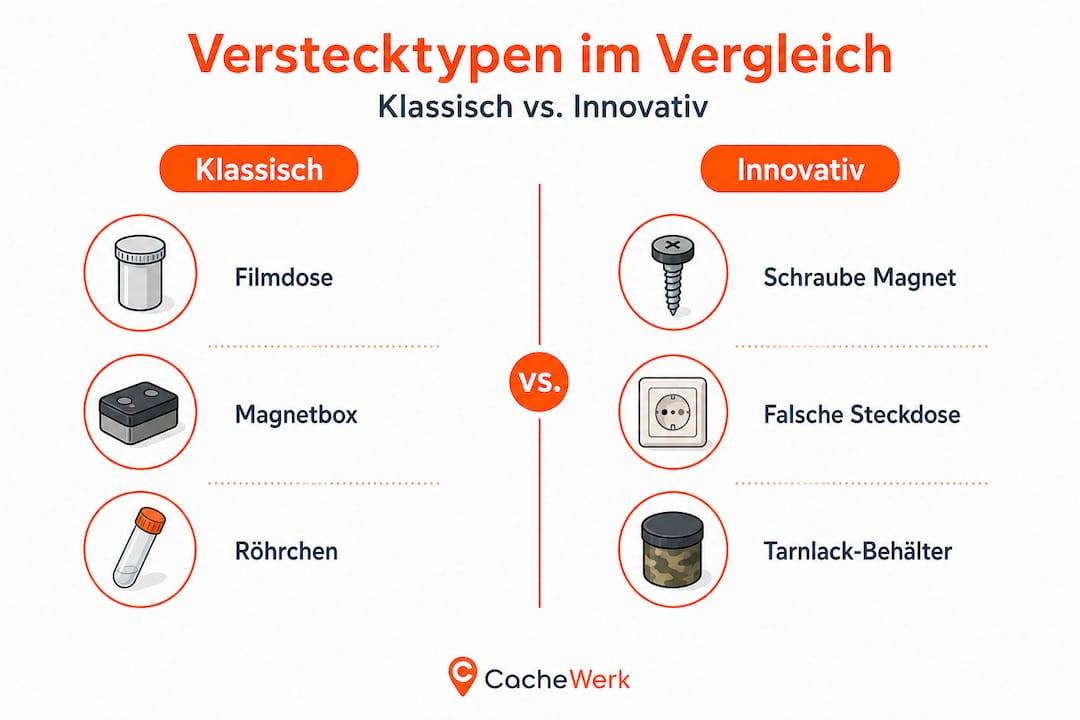
This overview makes it clear: quickly accessible hides perform better in almost all categories. This is no coincidence.
The Most Important Steps When Choosing the Right Hide Type
- Environmental analysis: Take a close look at the placement. Are there natural metal surfaces for magnets? Railings? Signs?
- Test access time: Access the planned hide yourself and time it. Over 20 seconds is too long.
- Suitable container: Choose a container that matches the existing material. A silver screw on a grey metal pole is almost invisible.
- Check logbook accessibility: The logbook must be removable and reinsertable without tools.
- Ensure weather resistance: Urban caches are exposed to rain, frost, and heat. PETG-printed housings or weather-resistant metal containers are ideal.
Pro tip: Visit the hide location at different times of the day. What looks quiet in the morning can be busy in the evening. The best camouflage is useless if the finder is rummaging in a crowd.
Do you want concrete inspiration? CacheWerk's creative urban cache ideas give you numerous suggestions for different types of environments.
Innovative Camouflage Techniques for City Caches
Now to the practical part: Which camouflage materials are particularly suitable for urban areas, and how can they be cleverly used?

Materials and Their Applications
The cityscape offers a wealth of natural camouflage possibilities. Metal dominates: lampposts, railings, bridge railings, distribution boxes, ventilation pipes. These surfaces are perfect carriers for magnetic hides.
“The city is not an obstacle to good camouflage. It is the best camouflage agent there is."
The "Hidden in Plain Sight: Urban Edition" theme clearly illustrates this: magnets, signs, and posts are not makeshift solutions but targeted camouflage tools in the urban landscape.
Here is an overview of the most common camouflage materials and their application:
| Material | Application Area | Advantage | Special Feature |
|---|---|---|---|
| Neodymium Magnet | Metal poles, railings, boxes | Extremely strong, fast | No tools needed |
| Camouflage Paint (grey, black) | Container exterior | Visual adaptation | Choose weather-resistant |
| Velcro fastener | Fabric, textile, plastic | Flexible attachment | For rough surfaces |
| PETG Print (3D) | Custom housings | Tailor-made | Robust, waterproof |
| Screw Dummy | Metal plates, railings | Perfect imitation | Often completely undiscovered |
Positioning in the Urban Landscape: The Decisive Art
A well-camouflaged container in the wrong place is still a bad hide. The positioning must be logical and credible. A magnetic nano cache on a park railing looks natural. The same cache on a wooden bench makes no sense and stands out.
The following urban objects are particularly suitable as carriers for hides:
- Traffic light poles: Metallic, often with rough surfaces and small openings. Magnets adhere well.
- Electrical distribution boxes: Large enough for bigger containers and present on almost every street.
- Bridge railings: Ideal for flat magnetic containers or screw dummies.
- Stair railings in parks: Less frequented, good camouflage potential.
- Signs and information boards: Backsides are classic hiding positions, but now also well-known.
Pro tip: Do not choose a hiding position that causes other people to also reach behind signs. A position that only seems logical to active searchers is better than one that could be accidentally discovered by passers-by.
The ideas for camouflage techniques on the CacheWerk blog show you how to cleverly combine different surfaces and environments.
Classic vs. Innovative: An Honest Comparison
Classic camouflage methods, such as simply hiding under a stone or in a tree hollow, work well in the forest but almost always fail in the city. In the urban landscape, undisturbed natural hides are rare. Here, innovative approaches clearly excel.
Classic container with lid: Easy to find because it doesn't match the surroundings. Magnetic screw on a metal pole: Almost invisible because it is part of the surroundings. The difference lies not in the quality of the container, but in the credibility of the camouflage.
Spoilers, Hints, and Community Interaction: The Balancing Act
In addition to camouflage, communication plays a crucial role: How are spoilers and hints optimally handled? This is a topic that is hotly debated in the community.
The Dilemma with Spoiler Photos
In the geocaching community, there are two clearly separated camps: some want to see photos of the hide to avoid damage from blind searching. Others see this as a clear spoiler that takes away the fun of discovery. Both sides have valid arguments.
A spoiler photo shows exactly where and how a cache is hidden. This protects the container from damage due to too intense searching. At the same time, it takes away the "aha" moment from the finder when they find the hide without help. In the urban cache scene, this moment is particularly valuable because the hides are often particularly clever.
Practical Rules for Good Hints
- Encrypt hint: Use the integrated ROT13 encryption on Geocaching.com so that only truly frustrated finders read the hint.
- Stay general: "Look closer than you think" is better than "second screw from the left, hip height."
- Address material: A hint about the container's material, such as "metallic and small," helps without spoiling.
- Describe position, don't show: "Near the bench" instead of "behind the left armrest of the park bench."
- Use a test person: Ask someone from the community to find the cache before listing. Is the hint fair? Is the search too long?
Pro tip: Add a note in the cache description that finders should contact you directly if they have difficulties, instead of damaging or giving up on the cache.
“A good hint doesn't make the cache easier. It makes it fairer."
Community Tips for Damage Prevention
Damage to caches usually doesn't happen out of malice, but out of frustration. A finder who searches unsuccessfully for 20 minutes will eventually become more aggressive in their search. The result: damaged containers, torn-out magnets, or forcibly opened locked housings.
The following measures significantly reduce the risk:
- Regular checks: Check your cache personally every few weeks.
- Take DNF logs seriously: If several finders cannot find the cache (DNF, i.e., "Did Not Find"), a quick check is advisable.
- Consider logbook capacity: A logbook that is too small leads finders to attempt creative, but damaging, solutions.
- Do not underestimate container quality: Cheap replacements rust, break, or open unintentionally.
- Plan for weather maintenance: Plan a check after heavy rain or frost, especially for magnetic hides.
My Experience: What Really Works for Urban Hiding
There's a tendency in the geocaching community that I've noticed for years: the more experienced a cacher becomes, the more complex their hides become. Puzzle containers with five steps, fake objects with hidden switches, elaborate mechanisms. This sounds impressive. And often, it is.
But in urban areas? This approach regularly fails there.
The Trap of Complexity
An elaborate mechanism takes time. Time a finder in public doesn't have without attracting attention. I have personally seen a technically brilliant hide discovered and emptied by Muggles within weeks. The reason: the finder took too long to operate the mechanism and was observed doing so.
The paradox is: the simplest hide in a good location often survives for years. A magnetic screw on an inconspicuous metal post at the right height, well-matched to the surroundings, is in practice the most durable hide I know.
What Really Matters: Context Beats Creativity
The crucial question is not "How creative is my hide?" but "Does my hide belong in this environment?" A gray nano tube on a gray metal surface belongs there. A conspicuous green container on a city tree does not, no matter how funny the design is.
Experienced geocachers from the community repeatedly confirm this: the best urban hides are those where finders retrospectively say, "I would never have found that if I hadn't specifically looked for it." Not because the hide was cleverly constructed, but because it was perfectly integrated into its surroundings.
The experiences with urban hides in the CacheWerk blog show that exactly this philosophy is behind the most successful urban caches.
The Uncomfortable Truth About Innovation
Innovation in the geocaching context does not always mean technical sophistication. Often, it means looking more closely than others. A valve cap that isn't really a valve cap. A screw that turns. A sticker that conceals a flap. These hides are innovative because they re-interpret the obvious, not because they are complicated.
Those who hide in urban areas should ask themselves less how to surprise finders and more how to bore Muggles. The goal is a hide where seekers are clearly recognizable for what they are doing: simply standing, briefly grabbing, leaving. Nothing more.
Next Steps: Urban Hiding with CacheWerk Products
You now have a solid overview of all important aspects of urban hiding. From permits to hide types to proper communication with the community. Now it's time to put that knowledge into practice.
CacheWerk offers the right assortment for exactly that. Whether you're looking for a magnetic screw dummy for the perfect city cache, a weather-resistant PETG special container, or clever camouflage for various surfaces: everything you need for your next urban hide can be found in one place. Check out the complete urban geocaching equipment and discover which products suit your planned placement. For extraordinary ideas, it's also worth taking a look at the special camouflage hides, which were developed specifically for challenging urban locations. Your next city cache is waiting.
Frequently Asked Questions
What permissions do I need to hide a geocache in the city?
You need the owner's or the responsible administration's approval before placing a cache. The official guidelines also emphasize that coordinates must be correctly stated and access must be safe.
How can I prevent Muggles from discovering a cache?
Choose easily accessible, inconspicuous hide types like magnetic screws and match the camouflage exactly to the environment. Complex mechanisms increase the risk of discovery because finders have to search visibly for longer.
What materials are suitable for camouflage in urban areas?
Magnets, camouflage paint, and everyday urban objects like railings or signs offer ideal possibilities. The 2026 annual theme specifically recommends magnetic screws, posts, and signs for urban camouflage.
How do I deal with spoilers and hints?
The balance of helpful, not too detailed hints and the avoidance of spoiler photos preserves the fun of the game and protects the cache. Controversial opinions show that some geocachers prefer photos to prevent damage, while others reject them as spoilers.
What mistakes should be avoided when hiding in the city?
Too conspicuous hides or those with long access times significantly increase the Muggle risk. According to experienced community members, easily accessible, integrated hides are the safest choice in the long term.