
Advantages of Modular Geocache Hides: Your Guide
Finding the right geocache hiding place is harder than many people think. Classic fixed caches rust, swell, or are difficult to salvage in case of location conflicts. This is precisely where the advantages of modular geocache hides become apparent: you can swap individual components, adapt designs, and move the cache to new locations without starting from scratch. This guide shows you why modular geocache systems are a real relief for cache owners. You'll get a practical overview of modular cache systems with concrete tips, comparisons, and recommendations for your next cache build.
Table of Contents
- Key Takeaways
- 1. Advantages of Modular Geocache Hides for Maintenance
- 2. Creative Design with Modular Cache Hides
- 3. Easy Adaptation to Site Conditions
- 4. Modular Systems vs. Classic Fixed Hides: A Comparison
- 5. Material Selection and Weather-Resistant Construction
- 6. Practical Tips for Using Modular Hides
- 7. Which Geocache Types Are Suitable for Modular Construction?
- 8. Dos and Don'ts When Combining Modules
- My Personal Assessment of Modular Hides
- Discover Modular Geocache Hides Directly at Cachewerk
- FAQ
Key Takeaways
| Point | Details |
|---|---|
| Maintenance made easier | If damaged, you only replace individual parts, not the entire hide. |
| Camouflage remains permanently intact | The outer casing remains untouched; only the logbook or container is replaced. |
| Location changes are quick | Modular setups can be dismantled and repositioned with little effort. |
| Creative design is encouraged | Modules can be combined and adapted to the environment and cache size. |
| Material choice determines longevity | Weather-resistant materials and careful construction are the key to success. |
1. Advantages of Modular Geocache Hides for Maintenance
The biggest advantage of modular geocache hides is obvious: if something breaks, you don't replace the entire hide. You only replace the affected part. This saves time, nerves, and money.
Imagine moisture has destroyed the logbook. With a classic fixed hide, you often have to replace the entire casing, apply new camouflage, and update the listing. With a modular system, you simply remove the container, replace it, and reassemble everything. Logbooks in modular containers, when used correctly, remain dry in outdoor use for over three years.
Advantages at a glance:
- Individual wear parts are replaced without tools
- The outer camouflage casing remains stable and untouched
- No need to re-apply for a new listing
- Short maintenance intervals that searchers hardly notice
Pro-tip: Keep a small supply of spare containers of your standard size. This way, you'll be done in minutes on your next maintenance visit, without having to drive to a shop.
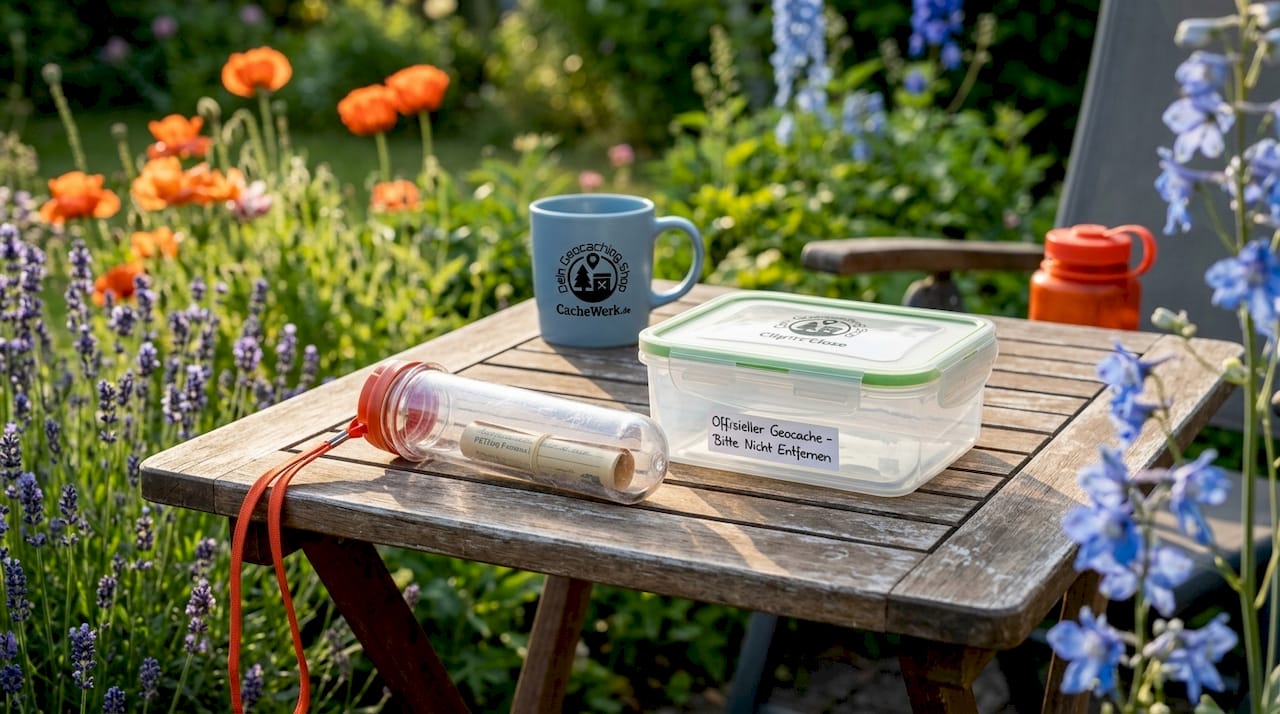
Proven standard components like PETlings or Clip'n'Close containers are robust, waterproof, and available in several sizes. They reliably function as the core of any modular setup and can be replaced at any time.
2. Creative Design with Modular Cache Hides
Modularity doesn't just mean function. It opens up a world of design possibilities. If you want to be creative when designing geocache hides, modular systems provide the perfect basis.
A particularly good example: mini pseudo birdhouses as cache casings. They are inconspicuous, blend perfectly into nature, and don't confuse muggles. At the same time, the inner container can be swapped as needed without touching the birdhouse itself. Insect hotels or small wooden boxes work similarly as modular camouflage casings.
Typical creative variations at a glance:
- Mini pseudo birdhouses in various sizes
- Deceptively real insect hotels made from natural materials
- Stone replicas with a removable core
- Tree bark replicas made from PETG or synthetic resin
- Fake signs with a hidden compartment inside
Another plus point: modular systems scale with your location. On a tree in the city center, you need a small, sleek casing. In the forest, a larger, more conspicuous camouflage piece also fits. You choose the outer module to match the surroundings and combine it with your standard container. Camouflages like birdhouses should be built in an adapted size to avoid misunderstandings with muggles.
Pro-tip: Build your camouflage casings to suit the season. A bare birdhouse in winter stands out. One made of weathered wood, on the other hand, looks credible for years.
3. Easy Adaptation to Site Conditions
Location conflicts are commonplace in geocaching. A new cache is placed nearby, the minimum distance of 161 meters is not met, or the property owner wants the cache removed. What then? With a classic fixed hide, almost everything starts from scratch. With a modular system, it's not a drama.
In 2026, a cache owner was able to quickly respond to a location conflict with a modular setup and move the cache without total loss. The outer casing remained, the container was removed, and the new location was activated in a short time.
Key advantages for location changes:
- The camouflage casing can be dismantled without tools
- Container and logbook remain undamaged
- New listing only needs coordinates to be changed
- Time and material effort are significantly reduced
Pro-tip: Coordination between caches is crucial. Always check the distances to existing hides before placing a new cache. Modular systems help you resolve location conflicts faster if they do arise.
For cache owners who operate multiple caches simultaneously, this advantage is particularly valuable. You not only save time on maintenance but also on the further development of your cache network.
4. Modular Systems vs. Classic Fixed Hides: A Comparison
To truly understand where modular geocache systems excel, a direct comparison is needed. The following table provides a clear overview of the most important criteria.
| Criterion | Modular Hide | Classic Fixed Hide |
|---|---|---|
| Maintenance effort | Low, individual parts replaceable | High, often complete replacement needed |
| Weather resistance | High, if properly constructed | Depends on material and construction |
| Camouflage remains permanently intact | Yes, outer casing remains | No, often lost if damaged |
| Flexibility for location changes | Very high | Low to non-existent |
| Creative potential | Great through combination | Limited to initial design |
| Repair costs | Low | High |
| Tool-free handling | Possible | Seldom possible |
The picture is clear. Modular cache systems offer advantages in almost all areas compared to classic constructions. Especially in the combination of ease of maintenance, camouflage preservation, and location flexibility, there is hardly a better choice. Only replacing the logbook or container while the camouflage remains on the outside is the most practical approach for durable hides.
5. Material Selection and Weather-Resistant Construction
A modular hide is only as good as its materials. The most common source of error in self-built geocaches is poor material selection for the outer casing. Danger lurks especially with wooden constructions.
Wooden casings must be treated to be weather-resistant to prevent mold and decay. This means: impregnating, varnishing, or priming with weather-resistant paint. If this is omitted, you often end up with a rotted casing after one winter. And that deprives the modular concept of its biggest advantage, namely that the casing remains permanently intact.
Good material options for modular camouflage casings:
- PETG from 3D printing: UV-resistant, dimensionally stable, easy to process
- Treated wood with weatherproof exterior paint
- Artificial stone or synthetic resin for realistic replicas
- Aluminum or coated sheet metal for urban environments
The inner container follows different rules. Here, the rule is: waterproof and robust. PETling or Clip'n'Close containers reliably meet this requirement. Another detail that many overlook: the ink for the logbook. In damp environments, the logbook paper should be printed or laminated so that it remains legible even with temporary moisture. Weather resistance through paint and construction is, according to experienced cachers, the most important factor for long-term success.
6. Practical Tips for Using Modular Hides
Do you want to start with modular geocache systems? Good. Here are concrete recommendations so that your project doesn't become an expensive experiment.
- Plan from the inside out. First, choose the standard container (container size, logbook format), then build the casing around it.
- Use only one container size per cache series. This way, you can keep spare containers in stock and react flexibly to any maintenance visit.
- Label all modules. Mark the top and bottom as well as the mounting direction with a waterproof pen. This saves time when assembling on site.
- Opt for detachable connections. Screws, clips, or magnets instead of glue. What you have to glue is difficult to replace.
- Actively maintain the listing. Note in the listing text that it is a modular system and which containers are used. Finders will then know what to expect.
- Check the hide after the first winter. The first winter shows where the weak points are. React early before a finding problem arises.
- Document your setup with photos. If you have to rebuild the hide after a long time, you'll immediately know what it looked like.
Pro-tip: Never combine too many different modules in a single hide. If you combine three different clip systems, two materials, and four components, you quickly lose track and make maintenance unnecessarily complicated. Keep it simple and repeatable.
For deeper inspiration for creative construction, it's worth taking a look at CacheWerk's hiding tips. There you'll find step-by-step ideas specifically for modular and creative geocaches.
7. Which Geocache Types Are Suitable for Modular Construction?
Not every cache type benefits equally from modular systems. A brief overview helps you choose the right concept for your next cache.
Traditional Cache: Ideal for modular systems. The hide remains in the same place; only the contents are renewed as needed. Maintenance is minimal; camouflage remains permanently intact.
Multi-Cache: Modular stages make particular sense if you have several intermediate stages. Each stage can be maintained independently without deactivating the entire multi.
Mystery Cache: The final hide benefits from modular construction. If the location ever needs to be changed, it is enough to move the container and adjust the listing.
Earth Cache: Physical hides play no central role here. Modular systems are therefore less relevant.
Nano and Micro-Caches: Here, too, there are modular approaches, for example, magnetic mounting systems where the logbook tube is pulled out and replaced. Practical for urban locations with high finger wear due to frequent searchers.
Also, check out Cachewerk's Guide for Creative Outdoor Geocaches. It shows how different cache types can be implemented with modular casings.
8. Dos and Don'ts When Combining Modules
Modular freedom sometimes leads to experiments that don't work in practice. These points will help you avoid typical mistakes.
What you should do:
- Use standardized connection dimensions so that modules fit together
- Always test whether the casing is really waterproof before hiding it
- Supplement the interior with a desiccant if the environment is particularly humid
- Assemble new modules at the kitchen table and open and close them multiple times before taking them into nature
What you should not do:
- Mix materials that react differently to temperature fluctuations (e.g., metal directly on plastic)
- Glue what you want to replace later
- Make the hide too complex. If a finder takes two minutes to open it, it's too complicated
- Use untreated wood outdoors
The basic rule when building modular hides is: what can be easily disassembled can also be easily maintained.
My Personal Assessment of Modular Hides
I remember well when I took down my first handmade cache from the tree after two years. The casing was swollen, the camouflage was no longer recognizable, and the logbook was a mess. All the effort was for nothing.
Since then, I've almost exclusively built modular. What no one told me before: it's also simply more fun. Instead of burying a cache and hoping, I disassemble it in five minutes during each maintenance visit, replace what's necessary, and reassemble it. The camouflage casing often lasts for years, and the contents are regularly refreshed.
What I've learned in practice: most problems don't arise from the idea itself, but from poor material combinations or overly complicated designs. Anyone who builds simply and uses good basic components like PETlings or Clip'n'Close containers has a real long-term advantage with the modular approach.
Modular systems also encourage tinkering. You start thinking about construction and design, not just about hiding. Honestly, that has made my enjoyment of geocaching even greater. If you love creative hides and don't want to constantly start from scratch, modular caching is really a good choice.
— Benedikt
Discover Modular Geocache Hides Directly at Cachewerk
Are you excited to build your next hide modularly? Cachewerk has just the right assortment for it.
A highlight from the shop is the Fake Road Sign as a Hide. It is a typical example of a modular system: the outer sign remains permanently at the location, while the inner container can be removed and replaced without tools. Inconspicuous, weather-resistant, and suitable for urban use. For those who prefer to browse: In the Geocaching Equipment and Accessories section, you will find not only modular hides but also suitable camouflage material, logbooks, and 3D-printed PETG components. Everything you need for a durable, low-maintenance cache.
FAQ
What are the advantages of modular geocache hides?
Modular geocache hides can be disassembled into individual parts, so only damaged components need to be replaced. This saves time, money, and permanently maintains camouflage.
Which containers are suitable for modular cache systems?
PETling and Clip’n’Close containers are proven standard components for modular systems. They are waterproof, robust, and available in several sizes.
How does a modular design help with location changes?
A modular hide can be quickly dismantled and re-erected at a new location without damaging the casing. Only the coordinates in the listing need to be adjusted.
Which materials are best suited for camouflage casings?
PETG from 3D printing and weather-resistant treated wood are particularly durable. It is important that the material can withstand temperature fluctuations and moisture.
For which geocache types is a modular system particularly worthwhile?
Traditional Caches and Multi-Caches benefit most from modular systems. Each stage can be maintained independently without having to deactivate the entire cache.
