
Geocaching Communities: Fostering Exchange and Creativity
TL;DR:
- Community exchange fosters innovation, tips, and creative hiding ideas in geocaching.
- Events strengthen social networks, facilitate experience sharing, and offer valuable learning opportunities.
- For owners, community resources are essential for coordinates, maintenance, and feedback.
The community is not just a meeting point for geocaching enthusiasts, but a real catalyst for innovative hiding spots, helpful tips, and sustainable exchange between beginners and experienced cache owners. Many underestimate how much knowledge and creativity arises from the community spirit. Geocaching communities enable the exchange of experiences, tips, and creative hiding ideas that individual geocachers would hardly develop on their own. Those who actively participate not only improve their own caches but also enrich the entire geocaching experience for everyone. This article shows you how communities function, what advantages they offer, and how you, as an owner or seeker, can benefit from them.
Table of Contents
- What makes geocaching communities so valuable?
- Joint Events: Social Interaction and Networking
- Support for Cache Owners: Practical Help and Knowledge
- Discussion and Controversies: Diversity, Edge Cases, and Challenges
- What Community Experts Really Recommend
- How to strengthen the community – with CacheWerk
- Frequently Asked Questions
Key Insights
| Point | Details |
|---|---|
| Exchange promotes quality | Through the exchange of experience in communities, better and more creative geocaches are created. |
| Events strengthen networks | Joint events offer knowledge, contacts, and fresh ideas for beginners and experienced geocachers. |
| Community helps owners | Cache owners benefit from collective expertise and support in maintenance, coordinate measurement, and guidelines. |
| Discussion brings diversity | Controversies about hiding types, puzzles, and muggle risks promote innovation and reflection in the scene. |
What makes geocaching communities so valuable?
At first glance, geocaching is an individual sport. You search, you find, you log. But those who delve deeper quickly realize: the best caches are rarely created alone. Behind every clever hiding spot there is often years of experience, gained through exchange within the community.
The core of every active geocaching community is knowledge transfer. Experienced geocachers share camouflage techniques, give tips on weather-resistant mounting, and explain which materials hold up best in certain environments. Beginners directly benefit from this, without having to make years of mistakes themselves. This saves time and frustration.
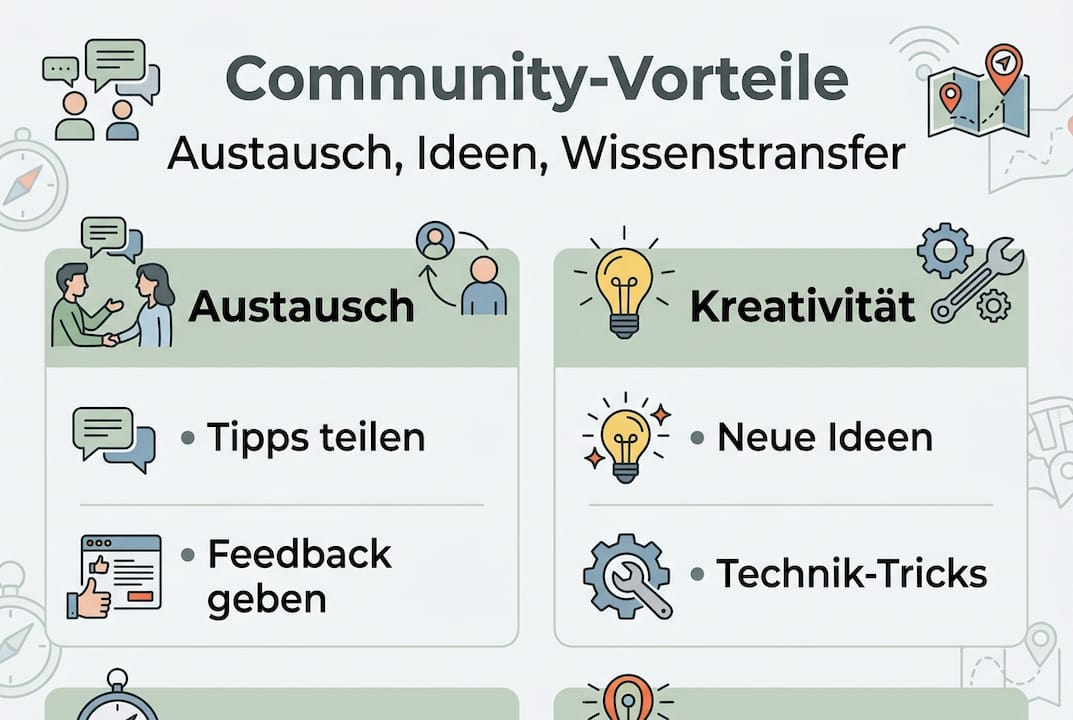
Furthermore, communities function as idea factories. If you ask a question about creative hiding techniques in a forum, you often get dozens of answers with completely different approaches. Some ideas are simple and immediately implementable, others are technically demanding and inspire entirely new projects. Those who want to discover creative hiding spots will find an inexhaustible source in active forums.
Community members motivate each other. A friendly log, constructive feedback, or an invitation to the next event can make the difference between someone staying involved or giving up the hobby. This social component is often underestimated.
Important functions of an active geocaching community:
- Knowledge Transfer: Tips on hiding techniques, materials, and maintenance
- Networking: Contacts with other geocachers and owners in the region
- Motivation: Mutual support and recognition
- Idea Development: Creative impulses through discussions and examples
- Problem Solving: Quick help with technical or logistical questions
"Many good caches emerge from the exchange of experiences in forums and events. Those who use the community place better caches."
Forums like Geoclub.de, Facebook groups, and events are the most important platforms for this exchange. There, geocachers discuss new ideas daily, share photos of their hiding spots, and help each other with problems. The basics of geocaching are quickly learned, but the subtleties of cache design and maintenance require precisely this kind of community knowledge.
The combination of digital and real exchange is particularly valuable. Online forums offer round-the-clock access to knowledge, while events enable personal contact. Both together provide a strong foundation for continuous learning and creative development.
Joint Events: Social Interaction and Networking
In addition to digital exchange, real-world interaction at events plays an important role. Geocaching events are far more than social gatherings. They are structured opportunities to build networks, share knowledge directly, and forge new friendships.
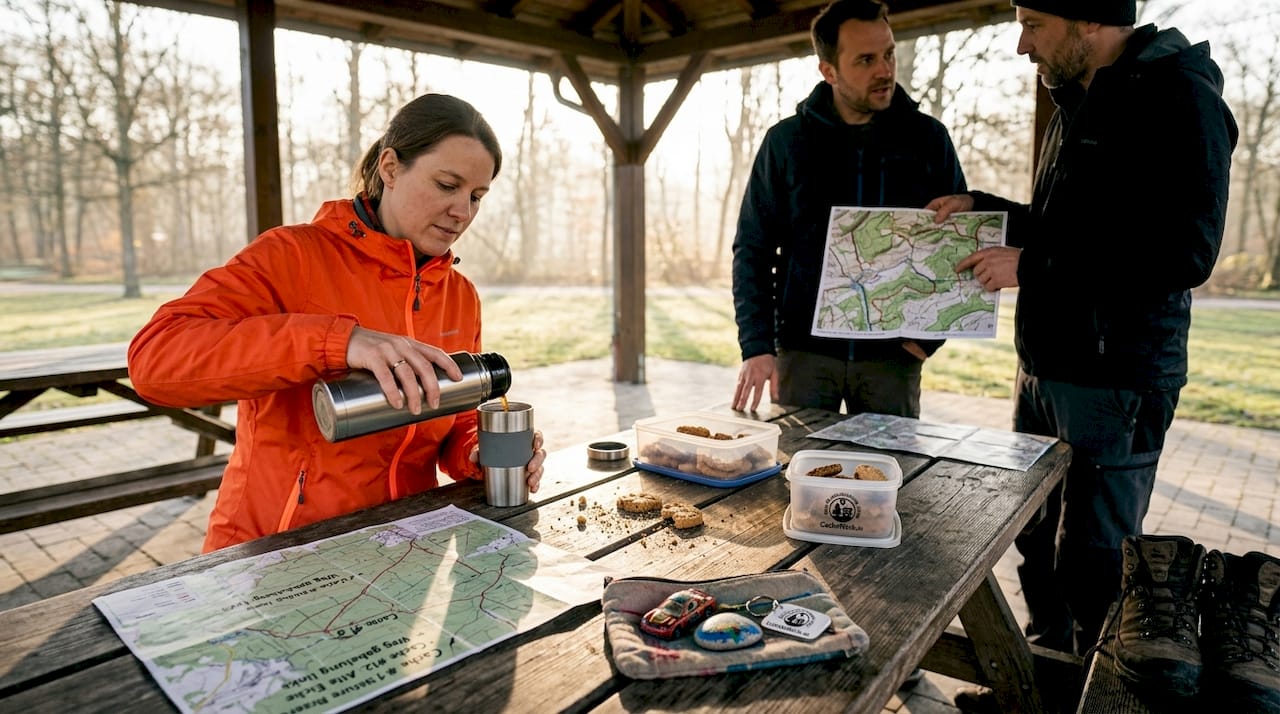
There are different types of events that vary in size and focus. Mega and Giga-Events foster social interactions and community building on a completely different level than small local gatherings. Hundreds or even thousands of geocachers from different countries meet here.
| Event Type | Number of Participants | Special Feature |
|---|---|---|
| Community Celebration Event (CCE) | 10 to 50 | Local exchange, personal atmosphere |
| Mega-Event | 500 or more | Interregional networking, many activities |
| Giga-Event | 3,000 or more | International community, large-scale event |
| CITO Event | variable | Cache In Trash Out, focus on nature conservation |
For beginners, CCE events are particularly recommended. The smaller group allows for genuine conversations and direct learning from experienced geocachers. In event inspirations, you can find ideas on how to organize or participate in an event yourself.
How to prepare for an event:
- Secure registration early: Popular events fill up quickly.
- Update geocaching app: To find all event caches in the area.
- Bring business cards or trackables: Ideal for networking and trading.
- Prepare questions: Use the opportunity to speak directly to experienced owners.
- Remain open to spontaneity: The best conversations often arise unplanned.
The Mega-Event definition shows that such events are internationally recognized geocaching milestones. Anyone who has participated in a Mega-Event understands immediately why these events are so formative for the community. The energy that arises when thousands of geocachers come together is unique and provides long-term motivation.
Events also offer valuable opportunities for cache owners. You can present your hiding ideas directly, gather feedback, and ask other owners about their experiences. This direct feedback is often more honest and concrete than comments in the log.
Support for Cache Owners: Practical Help and Knowledge
Owners also benefit enormously from community resources. Here, mutual support and know-how are shared that is not found in any official manual.
A common problem for new owners is accurate coordinate measurement. Small errors lead to seekers searching meters away and giving up frustrated. Communities support cache owners with mechanics such as coordinate measurement, adherence to guidelines, and maintenance. Joint measurement with an experienced geocacher significantly reduces these errors.
Maintenance is another topic that owners often underestimate. A cache that fills with water after the first rain or whose lid no longer closes after three months leaves a bad impression. The community helps with concrete recommendations for materials, seals, and mounting methods.
Practical support offered by the community:
- Coordinate Check: Joint measurement before activation
- Beta Testing: Experienced geocachers test the cache before going live
- Guideline Discussion: Clarification of edge cases in reviewer communication
- Maintenance Tips: Recommendations for containers, seals, and camouflage materials
- Problem Solving: Quick help with muggle-prone or damaged caches
Beta testing is particularly valuable. If you have your new cache tested by two or three experienced geocachers before publishing it, you avoid typical beginner mistakes. You get honest feedback on the difficulty, the logic of the puzzle, and the quality of the hiding spot. Practical owner tips help you systematically implement these steps.
Pro-Tip: Contact your responsible reviewer early, before submitting a complex cache. Many reviewers give informal hints in advance that prevent later rejections. Combine that with feedback from the forum, and your cache has a strong foundation from the start.
Community support doesn't stop after publication. Active owners carefully monitor their logs and respond to community feedback. If multiple geocachers write in the log that the container is taking on water, that's a clear signal for maintenance. Those who take this feedback seriously will have happier finders in the long run.
Discussion and Controversies: Diversity, Edge Cases, and Challenges
Alongside harmonious exchange, there are also controversial debates within the community. And that's a good thing. Discussions show that the community is alive and that real opinions are being expressed.
A classic contentious issue is fishing caches. These are hiding spots where a magnetic container is lowered into a cavity on a string. Discussions about fishing caches being prone to muggles show that many experienced geocachers view this method critically. The risk of being observed by muggles is high, and the mechanism can quickly fail.
Power trails are another touchy subject. Hundreds of caches along a route sound tempting for statistics collectors, but the community intensely discusses quality versus quantity. Many experienced geocachers prefer a single outstanding cache in a special location over twenty generic film canisters.
| Cache Type | Community Opinion | Main Criticism |
|---|---|---|
| Fishing Cache | Divided | Muggle risk, mechanical failure |
| Power Trail | Critical | Quality suffers from quantity |
| Mystery Cache | Predominantly positive | Puzzle must be fair and solvable |
| Nano Cache urban | Positive with reservation | Muggle-prone in busy areas |
The debate about geocaching controversies also revolves around the question: What makes a good cache? Location or puzzle? Many experienced geocachers clearly answer: the location. A cache at a breathtaking viewpoint with a simple container is more valuable than a complex puzzle leading to an uninteresting place.
Methods for risk minimization with problematic hiding spots:
- Careful site selection: Prefer less frequented areas
- Robust mechanics: Simple solutions last longer than complex constructions
- Regular maintenance: Frequent checks prevent failures
- Utilize community feedback: Community experiences reveal weaknesses early
- Clear hints in the listing: Seekers know what they are getting into
Controversies are not a sign of weakness in the community. They show that geocachers take their passion seriously and set high standards. Those who follow these discussions learn more about good cache design than from any tutorial.
What Community Experts Really Recommend
After years in the geocaching community, one thing stands out: the geocachers who benefit most from the community are not the loudest, but the most observant. They listen, ask questions, and consistently implement feedback.
A common mistake is to use the community only passively. Those who only read but never share themselves miss out on the real added value. Reciprocity is the engine of every vibrant community. Those who receive a tip pass it on. Those who find a cache leave an honest log.
Good caches prioritize location over puzzle; communities recommend events for networking and beta testing. This insight sounds simple, but many owners ignore it. They invest hours in complicated puzzles and neglect whether the destination is even worth a visit.
Beta testing is massively underestimated. Having your cache tested by three experienced geocachers before release saves dozens of maintenance logs and negative experiences later. Expert experiences clearly show: Open discussion and active listening are the strongest tools of a successful owner.
Pro-Tip: Owners who discuss openly, accept criticism, and continuously improve their caches build a loyal community of finders in the long run. This is more sustainable than any short-term hype around a new cache.
How to strengthen the community – with CacheWerk
Those looking for inspiration and tangible solutions will find the right products at CacheWerk for more fun and success in everyday community life. The connection between community knowledge and high-quality equipment makes the difference between an average and a truly exciting cache.
At CacheWerk, you'll find geocaching accessories that are precisely tailored to the demands of active geocachers and owners. Whether it's weather-resistant containers, camouflage materials for urban hiding spots, or trackables for events, everything is here. For special projects, our creative special caches offer innovative solutions that generate enthusiasm in the community. Plan your next community event with the right tools and leave a lasting impression on every finder.
Frequently Asked Questions
How do I find an active geocaching community in my region?
Regional forums like Geoclub.de and local Facebook groups are ideal starting points. Events, regular meetups, and regional gatherings are regularly announced there.
What are the benefits of a community for me as a cache owner?
You receive support with maintenance, coordinate measurement, and guidelines, as well as quick help with problems and creative impulses for new hiding spots.
Why are community events particularly helpful for beginners?
New geocachers learn from more experienced ones at events, get direct inspiration for hiding spots, and make valuable contacts for the future.
What are the most common points of contention in the community?
Fishing caches and power trails are controversially discussed, as well as the question of whether location or puzzle is more important for a good cache.