
PETG pour les caches de géocaching : Guide d'impression 3D 2026
Beaucoup de géocacheurs pensent que tous les matériaux d'impression 3D sont aussi robustes les uns que les autres. Pourtant, la structure moléculaire fait toute la différence entre une cache qui dure des années et une autre qui cède après quelques mois. Le PETG, grâce à sa composition modifiée au glycol, offre des avantages uniques pour les caches de géocaching résistantes aux intempéries. Ce guide vous montrera pourquoi le PETG est idéal, quels réglages d'impression garantissent des résultats optimaux et comment protéger vos caches imprimées en 3D à long terme.
Table des matières
- Pourquoi le PETG est le matériau idéal pour les caches de géocaching
- Les réglages d'impression 3D les plus importants pour des caches PETG solides et résistantes aux intempéries
- Comparaison des matériaux populaires pour les caches de géocaching : PETG, PLA et ASA
- Conseils pratiques pour le stockage et l'entretien des caches de géocaching imprimées en 3D en PETG
- Découvrez des caches de géocaching résistantes aux intempéries sur CacheWerk
- Questions fréquemment posées
Points clés
| Point | Détails |
|---|---|
| Le PETG est résistant aux intempéries et durable | Le matériau résiste à des températures de -20°C à 70°C et offre une haute résistance aux chocs pour les caches extérieures. |
| Les réglages d'impression optimisent la résistance | La température de la buse, la densité de remplissage et les réglages de rétraction influencent considérablement l'étanchéité et la durabilité. |
| Un stockage correct prévient les erreurs d'impression | Le PETG est hygroscopique et doit être stocké au sec pour éviter le "stringing" et la perte de qualité. |
| L'ASA offre une meilleure protection thermique | Pour une exposition UV extrême, l'ASA est plus approprié, mais le PETG équilibre de manière optimale les coûts et la fonctionnalité. |
Pourquoi le PETG est le matériau idéal pour les caches de géocaching
Le PETG se distingue des autres matériaux d'impression 3D par sa structure moléculaire unique. La modification au glycol perturbe la cristallinité du polymère, ce qui confère au matériau une flexibilité et une résistance aux chocs exceptionnelles. Cette propriété fait du PETG le premier choix pour les géocaches imprimées en 3D qui doivent résister à des conditions météorologiques rigoureuses.
La résistance aux chocs du PETG dépasse nettement celle du PLA. Le matériau résiste à des températures de -20°C à 70°C tout en conservant sa forme. Contrairement au PLA, qui devient cassant par temps froid, le PETG conserve ses propriétés mécaniques sur une large plage de températures. Cette caractéristique protège vos caches des chocs thermiques lorsque les températures varient fortement entre le jour et la nuit.
L'étanchéité est un facteur critique pour les caches de géocaching. Le PETG a une résistance à la traction de 40-60 MPa et un faible taux d'absorption d'eau, ce qui protège de manière fiable les carnets de bord et le contenu de la cache de l'humidité. La structure moléculaire dense empêche l'eau de pénétrer par des micro-canaux, même en cas d'exposition prolongée.
La stabilité aux UV est une autre force du PETG. Alors que le PLA se dégrade rapidement sous l'exposition directe au soleil, le PETG présente une résistance modérée aux UV. Pour les caches situées dans des endroits ensoleillés, il est cependant recommandé d'utiliser des variantes de PETG stabilisées aux UV, spécialement formulées pour les applications extérieures.
Astuce de pro : Choisissez des variantes de PETG résistantes aux UV pour les caches exposées directement au soleil. Celles-ci contiennent des absorbeurs d'UV qui ralentissent la dégradation des chaînes polymères et prolongent la durée de vie de votre cache de plusieurs années.
Le PETG offre les avantages suivants pour les caches de géocaching :
- Une haute résistance aux chocs protège des contraintes mécaniques causées par les animaux ou les branches tombantes.
- La résistance à la température permet un placement toute l'année sans défaillance matérielle.
- Une faible absorption d'eau prévient le gonflement et la déformation en cas d'humidité.
- Une résistance modérée aux UV prolonge la durée de vie en extérieur par rapport au PLA.
- Une bonne adhérence entre les couches réduit le risque de délamination lors des changements de température.
Les experts confirment la supériorité du PETG pour les applications extérieures. Un scientifique des matériaux explique : « La combinaison de la résistance aux chocs, de la tolérance à la température et de la résistance chimique fait du PETG le compromis optimal pour les pièces extérieures fonctionnelles qui doivent gérer à la fois les contraintes mécaniques et les intempéries. »
Les réglages d'impression 3D les plus importants pour des caches PETG solides et résistantes aux intempéries
Les bons réglages d'impression déterminent la qualité et la durabilité de vos caches PETG. La température de la buse influence directement la diffusion des chaînes polymères entre les couches. Une température proche de la limite de dégradation thermique maximise l'adhérence des couches et l'étanchéité, sans endommager le matériau.
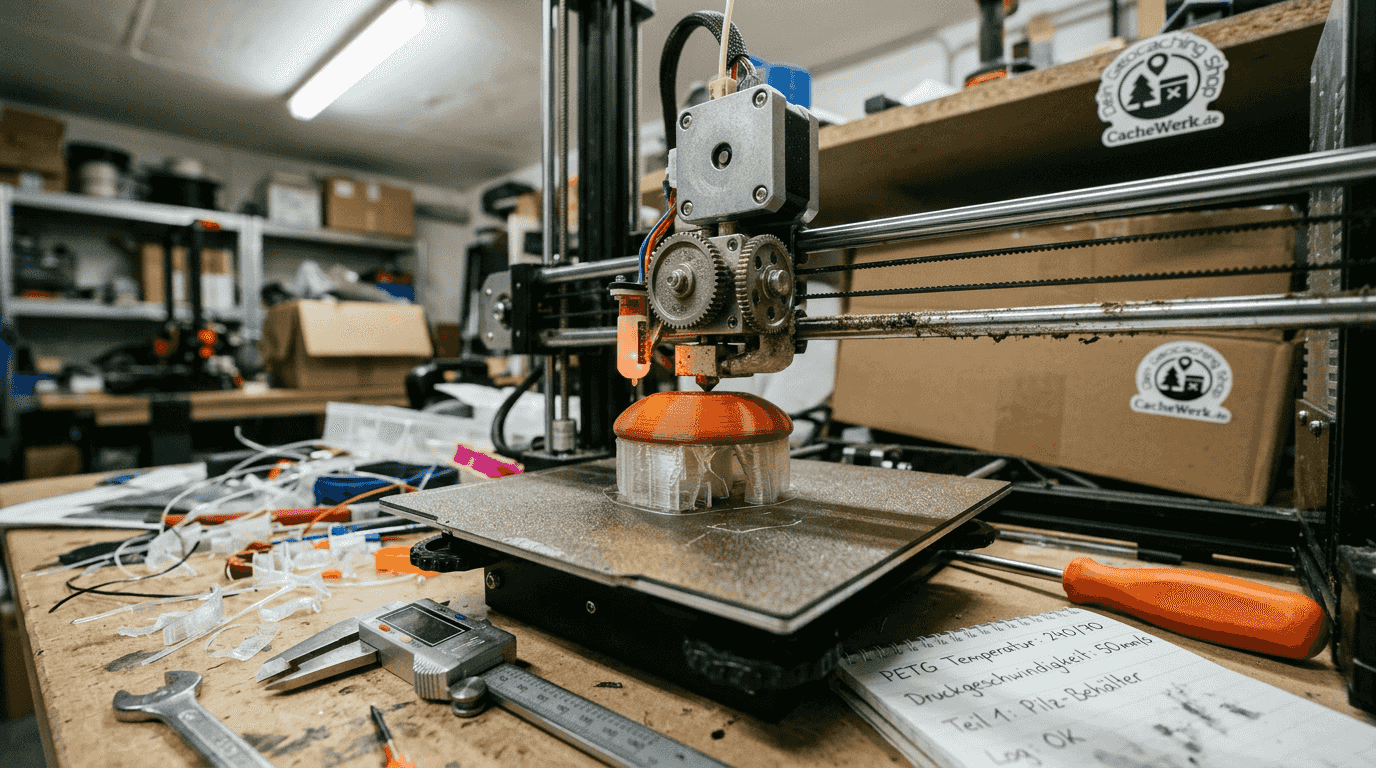
Les températures optimales de la buse pour le PETG se situent entre 230°C et 250°C. À des températures plus basses, les chaînes polymères ne diffusent pas suffisamment, ce qui crée des liaisons de couches faibles. Des températures trop élevées entraînent une dégradation thermique et une décoloration. Testez votre marque de filament spécifique pour trouver le point idéal.
La densité de remplissage détermine la résistance mécanique de votre cache. Une densité de remplissage plus élevée et des réglages de vitesse adaptés améliorent considérablement la résistance mécanique et la résistance aux intempéries. Pour les caches de géocaching, des valeurs de remplissage entre 50% et 100% sont recommandées, en fonction de la contrainte attendue.
Les réglages de rétraction sont critiques pour le PETG, car le matériau a tendance à faire du "stringing". L'équilibre entre une rétraction suffisante et une bonne adhérence des couches nécessite un étalonnage précis. Les valeurs typiques se situent autour de 3-5 mm de distance de rétraction et 25-40 mm/s de vitesse de rétraction.
Astuce de pro : Ajustez progressivement les réglages de rétraction. Commencez par des valeurs conservatrices et n'augmentez la distance de rétraction que de 0,5 mm par test pour minimiser le "stringing" sans compromettre l'adhérence des couches.
Suivez ces étapes pour des réglages d'impression PETG optimaux :
- Étalonnez la température de la buse avec une tour de température entre 230°C et 250°C.
- Réglez la densité de remplissage à au moins 50% pour une solidité structurelle.
- Réduisez la vitesse d'impression à 40-60 mm/s pour une meilleure adhérence des couches.
- Configurez la rétraction à une distance de 4-5 mm et une vitesse de 30-35 mm/s.
- Activez un plateau chauffant à 70-80°C pour une adhérence optimale.
- Désactivez les ventilateurs ou réglez-les à un maximum de 30% pour un refroidissement spécifique au PETG.
Ce tableau montre l'influence de la température et du remplissage sur les résultats d'impression :
| Paramètre | Réglage bas | Réglage optimal | Réglage haut |
|---|---|---|---|
| Température de la buse | 220°C, faible adhérence | 240°C, forte liaison | 260°C, dégradation |
| Densité de remplissage | 30%, faible résistance | 70%, haute stabilité | 100%, résistance maximale |
| Vitesse d'impression | 30 mm/s, temps d'impression long | 50 mm/s, bon équilibre | 80 mm/s, faible adhérence |
| Hauteur de couche | 0,1 mm, détails fins | 0,2 mm, standard | 0,3 mm, impression rapide |
La combinaison de ces paramètres détermine la qualité finale. Les caches pour des conditions extrêmes bénéficient d'une densité de remplissage plus élevée et d'une température optimisée, tandis que des designs simples peuvent se contenter de réglages standard. Expérimentez avec les réglages d'impression 3D pour géocaches afin de trouver l'équilibre parfait pour vos besoins spécifiques.
Comparaison des matériaux populaires pour les caches de géocaching : PETG, PLA et ASA
Le choix du bon matériau dépend de vos besoins spécifiques. Chaque matériau offre des avantages et des inconvénients différents pour les applications de géocaching. Ce tableau comparatif montre les principales différences :
| Paramètre | PLA | PETG | ASA |
|---|---|---|---|
| Résistance aux chocs | Faible, cassant par temps froid | Élevée, flexible | Très élevée |
| Résistance aux UV | Faible, se dégrade rapidement | Modérée, variantes UV bonnes | Excellente |
| Tolérance à la chaleur | Jusqu'à 60°C | Jusqu'à 70°C | Jusqu'à 95°C |
| Absorption d'eau | Élevée, gonfle à l'humidité | Faible | Très faible |
| Coût par kg | 15-25 Euros | 20-35 Euros | 30-50 Euros |
| Difficulté d'impression | Facile | Moyenne | Exigeante |
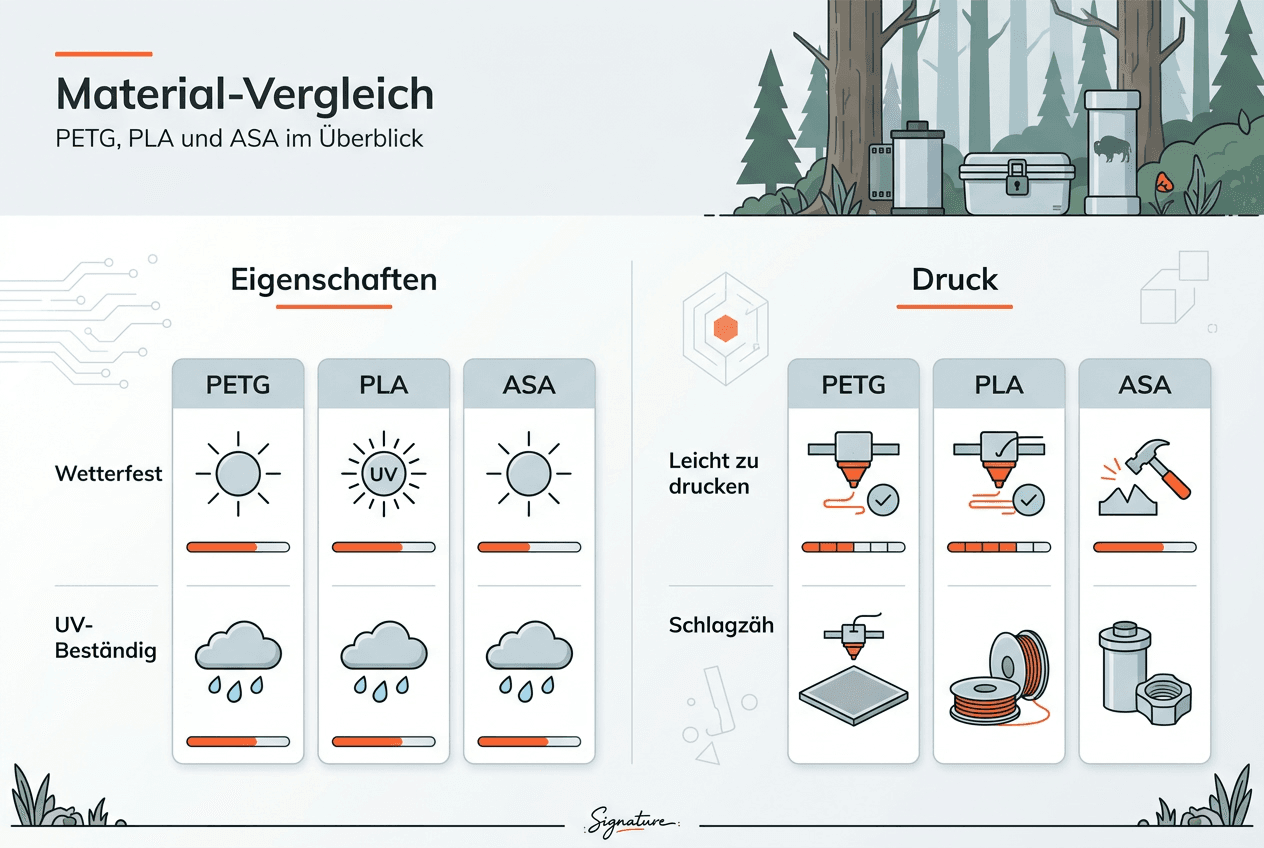
Le PLA est le matériau le plus facile à utiliser pour les débutants et s'imprime sans réglages compliqués. La basse température d'impression et la bonne adhérence le rendent idéal pour les premières tentatives. Cependant, pour les géocaches extérieures, le PLA est problématique car il est moins résistant aux intempéries et a tendance à se dégrader. Les rayons UV et l'humidité décomposent le polymère biodégradable en quelques mois.
Le PETG offre le meilleur compromis entre imprimabilité, coût et aptitude à l'extérieur. Sa résistance modérée aux UV et sa faible absorption d'eau en font le premier choix pour la plupart des caches de géocaching. Le PETG équilibre de manière optimale les coûts et la fonctionnalité, sans nécessiter les exigences extrêmes de l'ASA. Pour la comparaison des matériaux pour géocaches, le PETG est souvent la solution la plus pragmatique.
L'ASA surpasse nettement les deux matériaux en termes de résistance à la chaleur et aux UV. Des tests montrent que l'ASA est le plus performant en cas de températures élevées et d'exposition aux UV, tandis que le PETG équilibre les coûts et la durabilité en extérieur. Le prix plus élevé et les exigences d'impression plus complexes justifient l'ASA uniquement pour les environnements extrêmes tels que les déserts ou les régions tropicales.
Scénarios d'utilisation recommandés par matériau :
- PLA pour les caches intérieures, les prototypes ou les caches temporaires dans des environnements protégés.
- PETG pour les caches extérieures standard dans les climats tempérés avec une exposition modérée aux UV.
- ASA pour la chaleur extrême, l'ensoleillement intense ou les régions tropicales avec une forte exposition aux UV.
- PETG avec revêtement UV pour les endroits ensoleillés comme alternative économique à l'ASA.
- PLA uniquement pour les inlays de cache ou les éléments décoratifs, jamais comme matériau de boîtier principal.
Le choix du matériau doit également prendre en compte la disponibilité. Le PETG est largement répandu et disponible dans de nombreuses couleurs, tandis que le filament ASA est plus rare et plus cher. Pour la plupart des géocacheurs amateurs, le PETG offre le meilleur équilibre entre performance, coût et disponibilité.
Conseils pratiques pour le stockage et l'entretien des caches de géocaching imprimées en 3D en PETG
Un bon stockage commence par le filament lui-même. Le PETG est hygroscopique et absorbe l'humidité de l'air, ce qui affecte massivement la qualité d'impression. Un filament humide crée des bulles, du "stringing" et des liaisons de couches faibles. Stockez votre PETG dans des récipients hermétiques avec des sachets de gel de silice pour maintenir l'humidité relative de l'air en dessous de 20%.
Si votre filament a déjà absorbé de l'humidité, séchez-le avant l'impression. Utilisez un déshydrateur de filament à 60-65°C pendant 4-6 heures ou un four à basse température. Assurez-vous que la température ne dépasse pas 70°C pour éviter la déformation thermique de la bobine.
Les caches de géocaching finies nécessitent une inspection régulière. Contrôlez vos caches tous les 3 à 6 mois pour détecter des signes de dommages UV, de déformation ou de fissures. Surtout pour les caches exposées directement au soleil, les premiers signes de dégradation apparaissent souvent sous forme de décoloration ou de rugosité de surface.
L'exposition aux UV peut dégrader le PETG à long terme. Utilisez des sprays protecteurs résistants aux UV ou placez les caches dans des zones ombragées pour prolonger leur durée de vie. Les vernis de protection UV transparents à base d'acrylique offrent une protection supplémentaire sans altérer l'esthétique.
Nettoyez vos caches délicatement avec de l'eau savonneuse douce. Les produits de nettoyage agressifs ou les solvants peuvent attaquer la surface et enlever les couches protectrices. Évitez les nettoyeurs haute pression, car la pression de l'eau peut créer des microfissures qui entraîneront plus tard des fuites.
Astuce de pro : Faites pivoter ou déplacez les caches tous les 12-18 mois pour réduire l'exposition prolongée à des conditions extrêmes. Cette pratique prolonge considérablement la durée de vie et vous donne l'occasion d'effectuer des travaux d'entretien.
Étapes d'entretien importantes pour des caches PETG durables :
- Stockez le filament de rechange dans des conteneurs scellés avec des indicateurs d'humidité.
- Inspectez les caches tous les six mois pour détecter les dommages UV, les fissures ou les déformations.
- Appliquez un vernis protecteur UV sur les caches situées dans des endroits ensoleillés.
- Nettoyez les surfaces uniquement avec des nettoyants au pH neutre.
- Remplacez les joints toriques et les joints d'étanchéité annuellement pour les conceptions étanches.
- Documentez les intervalles d'entretien pour le stockage et la maintenance des géocaches.
Un entretien correct de vos caches PETG porte ses fruits à long terme. Les caches bien entretenues peuvent durer cinq ans ou plus, tandis que les caches négligées doivent souvent être remplacées en 12-18 mois.
Découvrez des caches de géocaching résistantes aux intempéries sur cachewerk
Après tous ces détails techniques, vous vous demandez peut-être où trouver des caches de géocaching de haute qualité, prêtes à l'emploi. CacheWerk propose une vaste sélection de caches créatives et résistantes aux intempéries, spécialement conçues pour une utilisation en extérieur. La gamme de produits comprend des designs innovants imprimés en 3D en PETG ainsi que des caches classiques pour les environnements les plus divers.
La collection Équipement et accessoires de géocaching offre tout ce dont les géocacheurs amateurs ont besoin pour des placements de cache réussis. Des matériaux de camouflage aux trackables en passant par les caches spéciales, vous trouverez des solutions bien pensées pour les emplacements urbains et ruraux. Les caches spéciales de géocaching se distinguent particulièrement par leurs designs créatifs qui surprennent même les géocacheurs expérimentés. Un point fort est la cache de géocaching Faux Panneau de Signalisation, qui élève le camouflage urbain à un nouveau niveau.
Questions fréquemment posées
Quels sont les meilleurs matériaux pour les caches de géocaching ?
Le PETG est idéal en raison de sa résistance aux intempéries, de sa résistance aux chocs et de son équilibre entre coût et performance. L'ASA convient mieux aux chaleurs extrêmes et à une exposition intense aux UV, mais coûte plus cher. Le PLA est moins cher et plus facile à imprimer, mais nettement moins durable en extérieur. Pour la plupart des géocacheurs amateurs, le PETG offre la combinaison optimale.
Comment éviter le "stringing" lors de l'impression 3D avec du PETG ?
Le "stringing" est causé par des températures de buse trop élevées et des réglages de rétraction insuffisants. Réduisez progressivement la température de 5°C et augmentez la distance de rétraction à 4-5 mm à une vitesse de 30-35 mm/s. Testez différentes combinaisons avec un modèle de test de "stringing" pour trouver les valeurs optimales pour votre filament spécifique. Désactivez ou réduisez la vitesse du ventilateur à un maximum de 30%.
Comment dois-je stocker le filament PETG pour préserver la qualité d'impression ?
Le PETG est hygroscopique et doit être stocké au sec. Utilisez des récipients hermétiques avec des dessiccants de gel de silice et maintenez l'humidité relative de l'air en dessous de 20%. Si le filament a déjà absorbé de l'humidité, séchez-le à 60-65°C pendant 4-6 heures dans un séchoir à filament. Ne stockez jamais les bobines entamées à l'air libre, car même 24 heures d'exposition peuvent altérer la qualité d'impression.
Combien de temps durent les caches PETG imprimées en 3D en extérieur ?
Les caches PETG bien imprimées et entretenues durent généralement 3 à 5 ans en extérieur. La durée de vie dépend de l'exposition aux UV, des cycles de température et des contraintes mécaniques. Les caches situées dans des zones ombragées ou avec un vernis de protection UV durent souvent plus longtemps que celles exposées directement au soleil. Des inspections et un entretien réguliers prolongent considérablement la durée de vie.
Puis-je traiter les caches PETG avec une protection UV après coup ?
Oui, les vernis acryliques transparents de protection UV sont excellents pour une protection ultérieure. Appliquez 2 à 3 couches fines avec un temps de séchage de 24 heures entre chaque application. Ce traitement prolonge considérablement la résistance aux UV et protège la surface des intempéries. N'utilisez que des vernis compatibles avec le PETG pour éviter les réactions chimiques.
Quelle densité de remplissage est optimale pour des caches de géocaching étanches ?
Pour les caches étanches, une densité de remplissage d'au moins 70 % est recommandée, idéalement 100 % pour les zones critiques comme les couvercles et les fonds. Combinez une densité de remplissage élevée avec 3-4 parois et 5-6 couches supérieures/inférieures pour une étanchéité maximale. Utilisez des motifs de remplissage gyroid ou cubique pour une résistance optimale avec une consommation de matériau modérée.