
Hook-and-Loop Hides in Geocaching: Guide 2026
Velcro hideouts are geocaching caches that are attached to trees, guardrails, rocks, or other surfaces with hook-and-loop fasteners, without the need for adhesive or magnets. This method is considered particularly flexible in the geocaching community because you can remove the cache without leaving any traces. This is a real advantage, especially for areas with sensitive nature or places where permanent fixings are not allowed. Cachewerk offers suitable materials and ready-made starter kits to make getting started much easier.
What are Velcro Hideouts in Geocaching?
Velcro hideouts, also known as "Velcro Caches" in technical terms, use the principle of hook-and-loop fasteners to attach a cache container to a surface. A strip of loop tape adheres to the surface, and a strip of hook tape adheres to the container. When you press them together, the cache holds securely. When you separate them, hardly any trace remains.
This fundamentally distinguishes Velcro hideouts from magnetic caches or containers attached with superglue. Magnets only work on metal surfaces. Glue leaves residues and is difficult to correct. Velcro hideouts, on the other hand, offer a releasable attachment that can be flexibly used on various surfaces such as tree bark or guardrails.
For geocachers who want to place multiple caches or move their cache to a new location after a while, this is a practical advantage. No tools, no solvent, no damage to the surface.
What are the advantages of Velcro hideouts for geocachers?
Velcro hideouts have several tangible advantages over other attachment methods. The most important ones at a glance:
- Removable without residue: You can remove the cache at any time and attach it elsewhere. No glue, no scratches, no problem.
- Flexible on many surfaces: Tree bark, wooden posts, plastic, rough stone surfaces. The principle works wherever the adhesive of the loop tape adheres.
- Inexpensive to purchase: Material costs under 15 Euros for a basic set are realistic, including duct tape and screw hooks. This makes Velcro caches one of the most affordable hiding methods ever.
- Quick to build: Preparation usually takes less than 30–60 minutes, including drying times. Experienced builders are even faster.
- Easy to maintain: If a strip comes loose, simply replace it. No rebuilding necessary.
Compared to magnetic caches, Velcro hideouts particularly shine where no metal is present. Compared to glued hideouts, they win due to their residue-free nature. Those who want to place caches in nature reserves or near historic buildings should generally opt for reversible methods. Velcro is the most obvious choice for this.
Pro tip: Test the adhesion of the Velcro before final assembly on a similar surface at home. Some surfaces, such as very smooth bark or painted wood, adhere significantly worse than rough surfaces.
Velcro hideouts are particularly suitable for families with children who want to place caches together. Crafting is simple, safe, and fun. Those looking for more creative ideas for outdoor activities with children will also find inspiration there.
What materials do I need for a Velcro hideout?
You don't need much for a functional Velcro hideout. The basic equipment consists of a few parts that you can combine well.
Velcro and Adhesive
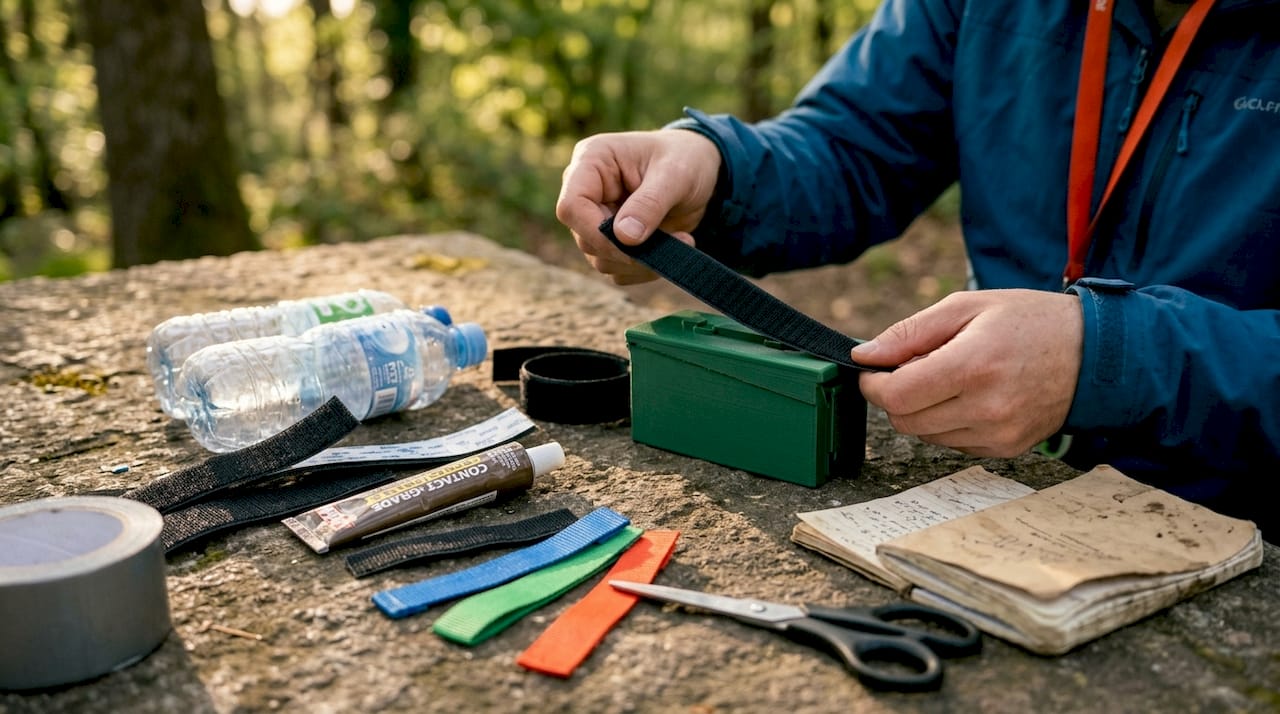
The core, of course, is the Velcro itself. Do not buy thin sewing Velcro from the haberdashery. For outdoor use, you need wide, self-adhesive Velcro with strong adhesive power, at least 20 mm wide. The adhesive layer on the back of the tape is crucial. The adhesive strength of self-adhesive Velcro tapes can decrease with strong temperature changes, which is why experienced crafters often use additional MS polymer-based mounting adhesive. This adhesive remains flexible even in frost and heat and does not tear off.
Cache container
PETlings or film canisters are often used for Velcro caches because they are easy to adapt and inexpensive. PETlings are waterproof, durable, and available in various sizes. Film canisters are suitable for nano and micro caches in inconspicuous places.
Additional materials
| Material | Purpose | Note |
|---|---|---|
| Duct tape | Reinforcement and camouflage | Weatherproof, tear-resistant, available in brown or green |
| Screw hooks | Additional securing | Useful on wooden posts or trees |
| Mounting adhesive (MS polymer) | Permanent hold | Better than household glue in cold weather |
| Logbook (waterproof) | Mandatory component of every cache | Fits in PETling or film canister |
| Tweezers | Remove logbook | Indispensable for small containers |
Cachewerk offers ready-made starter bundles that combine PETling, logbook, and holder. This saves time during assembly and ensures that all parts fit together.
Pro tip: Buy Velcro in rolls instead of small packets. A roll is enough for many caches and costs significantly less per meter.
How to build and place a Velcro hideout correctly?
Building a Velcro cache is straightforward if you follow the steps in the correct order. Mistakes usually happen during surface preparation or with the wrong type of Velcro.
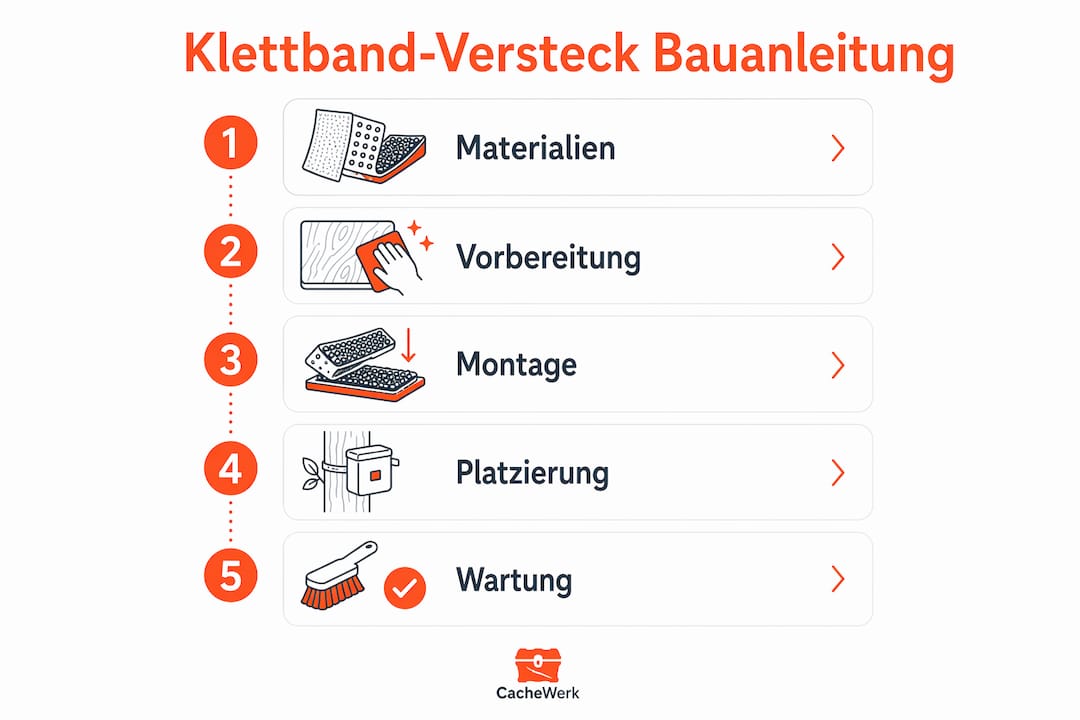
Step-by-step guide
-
Check the surface: Choose a surface that is rough enough for the adhesive of the loop tape to adhere. Remove dust, moss, or moisture. A dry, clean surface is essential.
-
Cut the Velcro: Cut hook and loop tape to the same length. For a PETling, two strips of 5 cm length and 20 mm width are usually sufficient. More surface area means more hold.
-
Attach loop tape to the surface: Peel off the protective film and press the loop tape firmly onto the surface. Hold it for at least 30 seconds. For permanent hold, additionally apply a drop of MS polymer adhesive under the edges.
-
Attach hook tape to the container: The hook tape adheres to the outside of the PETling or film canister. Make sure the surface is grease-free. Alcohol helps with degreasing.
-
Apply duct tape for protection: The combination of Velcro with duct tape significantly increases the weather resistance and camouflage of the hideout. Wrap a strip of duct tape around the edges of the loop tape on the surface.
-
Allow drying time: Let the adhesive cure for at least 24 hours before stressing the cache. If it's cold (below 10°C), wait 48 hours.
-
Do a test run: Attach the container and pull it off and reattach it several times. Does it hold securely? Is it straight? Only then insert the logbook and activate the cache.
The interplay of Velcro, adhesive, and surface significantly determines the longevity of a hideout in outdoor areas. Those who cut corners here will find their cache on the ground after the first storm.
Common placement mistakes
Many geocachers underestimate the influence of weather and surface quality. A Velcro cache on a south-facing metal surface will hardly hold in summer because the metal heats up to over 60°C and the adhesive softens. Shady, dry places with a rough surface are much more suitable. Furthermore, the cache should not hang in such a way that it swings back and forth in the wind. Movement loosens the adhesive bond over time.
How to camouflage and design Velcro hideouts in an environmentally friendly way?
Camouflage and environmental friendliness are two sides of the same coin with Velcro caches. A well-camouflaged cache goes unnoticed by muggles. An environmentally friendly designed cache leaves no damage to nature.
Specific tips for good camouflage:
- Match the color: Use brown or green duct tape that matches the bark or surface. Gray tape is suitable for stone or concrete.
- Wrap the container: Wrap the PETling with jute twine or duct tape. This breaks up the shiny surface and makes it less conspicuous.
- Add natural materials: Small pieces of bark or moss can be attached to the duct tape with a drop of adhesive. Make sure to only use fallen material, never tear off living plants.
- Leave no plastic waste: Use only weatherproof materials. Cheap tape disintegrates after a few months and leaves plastic fragments in nature.
- Test visibility: Step back three meters and see if you can still see the cache. If so, continue camouflaging.
Velcro hideouts allow for cache placement that leaves few traces and can be easily removed or relocated. This makes them ideal for sensitive natural areas. Those who regularly maintain their cache and replace damaged Velcro strips actively contribute to keeping the site clean.
Pro tip: Photograph your cache immediately after installation from a seeker's perspective. This way you can immediately recognize if it is truly inconspicuous, and you have a reference image for later maintenance visits.
Important Insights
Velcro hideouts are the most flexible and residue-free method for attaching geocaches permanently and inconspicuously in nature or urban areas.
| Topic | Details |
|---|---|
| Basic Principle | Hook-and-loop tape connects container and surface without glue or magnets. |
| Cost | A basic set costs less than 15 Euros and is sufficient for several caches. |
| Durability | MS polymer adhesive as reinforcement prevents detachment due to temperature fluctuations. |
| Camouflage | Duct tape in earth tones and natural materials make the cache invisible. |
| Environment | No permanent traces on the surface, easily removable and relocatable. |
My Experiences with Velcro Caches After Years in the Field
I have placed Velcro caches on birch bark, concrete pillars, and wooden fences. And I can say: The most common mistake is not the wrong Velcro, but the wrong adhesive underneath.
Normal household glue or cheap double-sided tape might last one summer. Then the loop tape detaches, and the cache ends up on the ground. Once you switch to MS polymer adhesive, you never go back. The difference is noticeable, especially after a harsh winter.
What also surprised me: Wide Velcro strips do not automatically hold better than narrow ones if the surface is uneven. On tree bark with deep grooves, a narrow strip that fits exactly into a groove often holds better than a wide one that only rests on the raised areas. This sounds counterintuitive but is practical.
For beginners, I recommend starting with a ready-made starter bundle. You get perfectly matched parts, save yourself the hassle of searching in the hardware store, and can focus on the essentials: finding a good hiding spot.
And one more thing: Plan maintenance visits from the start. Velcro caches are low-maintenance but not maintenance-free. Anyone who checks their cache twice a year will enjoy it for years.
— Benedikt
Ready-Made Kits for Your First Velcro Cache from Cachewerk
If you want to get started right away, Cachewerk has everything you need for a functional Velcro cache.

The Geocaching Starter Bundle 2 contains a PETling, logbook, and hanger in one set. Everything is coordinated and ready for immediate use. For crafters who want a bit more flexibility, the Geocaching Starter Bundle 1 offers a version with a holder instead of a hanger. Those looking for unusual hideouts will find a clever camouflage hideout with surprising attachment options in the Geocaching Ammo Box Trick Edition. All products are made from durable materials and are designed for outdoor use.
FAQ
What is a Velcro Hideout in Geocaching?
A Velcro hideout is a geocache that is attached to a surface with self-adhesive hook-and-loop fasteners. The method is reversible and leaves no damage to the surface.
Which Velcro is best suited for outdoor caches?
Self-adhesive Velcro with a minimum width of 20 mm and strong adhesive strength is recommended. For permanent outdoor hold, MS polymer-based mounting adhesive should also be used.
How long does a Velcro cache last outdoors?
With high-quality materials and regular maintenance, a Velcro cache can last for several years. Reinforcing the back with duct tape significantly increases weather resistance.
Can I place Velcro caches in nature reserves?
Velcro caches are generally better suited than glued or drilled hideouts because they leave no permanent marks. However, the applicable rules of the respective protected area and the geocaching guidelines from Groundspeak still apply and must be observed.
Which cache container best fits a Velcro hideout?
PETlings and film canisters are the most popular containers for Velcro caches because they are lightweight, waterproof, and easy to attach. Cachewerk offers ready-made bundles with PETlings and matching logbooks.
