
What Does "Spoiler" Mean in Geocaching? Clearly Explained
In geocaching, a spoiler is a hint, photo, or text that directly facilitates or even pre-empts finding a cache or solving a puzzle. The term comes from the English "to spoil" and, according to CacheWiki, describes exactly that: spoiling something. Those who use a spoiler often find the cache faster, but they sacrifice part of the searching experience. This is not a mistake but a conscious decision. And that is precisely why it is worth understanding the term.
Table of Contents
- What does "spoiler" mean in geocaching, and how does it differ from a hint?
- Why do owners use spoilers?
- How do you correctly embed spoilers in your listing?
- What should finders and owners consider in the community?
- Good and bad practice: Concrete examples
- When are alternatives to spoilers the better choice?
- When spoilers are constantly needed: Cachewerk solutions as an alternative
- Key Takeaways
- Spoilers from a pragmatic perspective
- Useful sources and further links
What does "spoiler" mean in geocaching, and how does it differ from a hint?
Both help in finding, but they do so in very different ways.

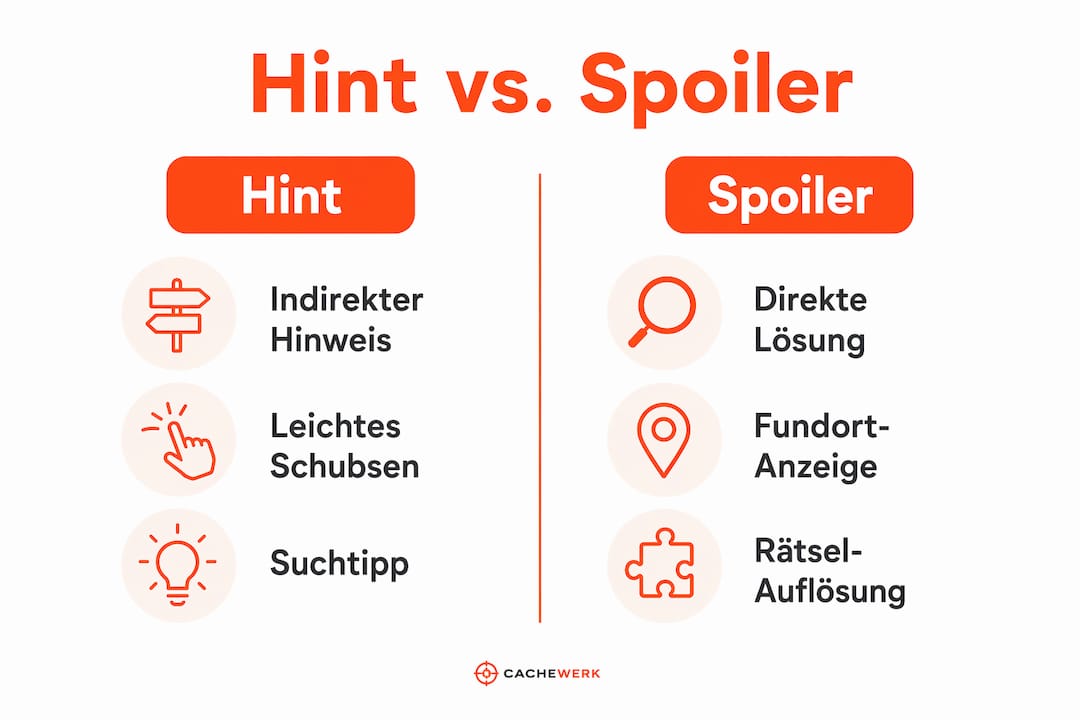
A hint is stored in the listing and gives a small push in the right direction. It rarely describes the hiding spot directly but suggests: "Look up" or "Think of magnets." A spoiler goes further. It shows or describes where the cache is located, what it looks like, or how the puzzle is solved. Geocaching.com defines a spoiler as information that reveals details and can ruin the experience of finding.
| Feature | Hint | Spoiler |
|---|---|---|
| Information depth | Suggestion, indirect clue | Direct solution or hiding spot |
| Visibility | Standardly encrypted in the listing | Image in gallery or text, opt-in possible |
| Typical form | Short text (ROT13) | Photo, detailed text, log entry |
| Player experience | Largely preserved | Partially or fully anticipated |
| Voluntariness | Finder decides themselves | Should be clearly marked as a spoiler |
In short: A hint still lets you search. A spoiler tells you where to look.
Why do owners use spoilers?
Spoilers have a bad reputation that they don't always deserve. There are good reasons why experienced owners use them strategically:
- Frustration avoidance: For complex puzzles or hard-to-reach hiding spots, a spoiler prevents finders from making multiple unsuccessful trips.
- Environmental protection: Intense searching without success can cause damage to the environment. A targeted hint protects sensitive areas.
- Poor GPS reception: In narrow city streets or dense forests, the displayed position often deviates by several meters. A spoiler compensates for this.
- Complicated puzzles: If a puzzle cache requires unusual knowledge, a spoiler can prevent finders from giving up.
- Urban micro-hides: Small magnetic containers in busy locations are hard to find without appearing suspicious. A photo helps more than any text here.
Pro-Tip: Always offer spoilers as a voluntary option. Mark them clearly and briefly explain why you've included them. This way, the challenge remains for everyone who seeks it.
How do you correctly embed spoilers in your listing?
Spoilers belong in the listing, not in the log. Here's how to implement them technically correctly:
- Upload and name image: Upload the photo using the gallery function in the listing. Explicitly name the file with "Spoiler" in the filename so finders immediately know what to expect.
- Set spoiler tag: On Geocaching.com, you can mark images in the gallery as spoilers. Images in galleries only become visible after being consciously clicked, which prevents unintentional spoiling while browsing.
- Remove EXIF data: Photos often contain GPS coordinates in their metadata. Remove these before uploading, for example, with Windows File Explorer (right-click, properties, remove details) or with a tool like ExifTool.
- Encrypt text hints: Textual spoilers in the hint field are encrypted by default using ROT13. Finders must actively click "Decrypt" to ensure opt-in.
- Add hint text: Write in the description: "Spoiler image available in the gallery." This lets finders know that help is available without accidentally stumbling upon it.
Pro-Tip: Prefer text spoilers over images if you want to appeal to paperless geocachers. Many do not load images in the field because they cache offline. A precise text hint reaches everyone.
What should finders and owners consider in the community?
The basic rule is simple: spoilers only when necessary, and always clearly mark them.
For Owners:
- Never place unmarked spoilers in the gallery.
- Briefly explain the purpose of the spoiler (e.g., "Help for poor GPS reception").
- Do not write spoilers in public logs. Those who need help can send a private message.
- Check before uploading: Is the image really necessary? Is a more precise hint sufficient?
For Finders:
- Only view spoilers after your own attempt has failed.
- Never reveal the hiding spot, exact position, or solution to a puzzle in the log.
- If you need help, send the owner a private message before spoiling in the log.
- If necessary, protect encrypted information in the log using ROT13 or a similar method.
The community is divided: some see spoilers as cheating, others as a legitimate last resort. Respectful interaction means acknowledging these different expectations.
Good and bad practice: Concrete examples
Here's where the difference lies in practice:
| Situation | Bad Practice | Good Practice |
|---|---|---|
| Photo in log | Unmarked image with visible hide | No image in log; spoiler only in listing |
| Gallery image | Filename "IMG_XXXX.jpg" | Filename "Spoiler_Hint.jpg" |
| EXIF data | GPS coordinates included in image | EXIF removed before upload |
| Log text | "Cache is under the third stone on the left" | "Nice find, thanks for the cache!" |
| Hint text | Openly readable without encryption | ROT13-encrypted, finder decides |
For paperless geocachers: Text spoilers are more reliable. Images are often not loaded in the app if there's no connection. A well-formulated text hint works just as well offline.
Checklist before uploading a spoiler image:
- Filename contains "Spoiler"
- Image marked as spoiler in the gallery
- EXIF data removed
- Hint added to the listing description
- Resolution appropriate (not too high, not too low)
When are alternatives to spoilers the better choice?
Before you publish a spoiler, a quick check is worthwhile: often there are alternatives that better protect the player experience.
- More precise hint: Revise the existing hint. Often, a more concrete phrasing is enough without directly revealing the hiding spot.
- Private message to finder: If someone asks for help in the log, reply via PM. This keeps the spoiler out of the public domain.
- Maintenance log: If a cache is hard to find because it has shifted or the environment has changed, update the listing or post a maintenance log.
- Rethink cache design: Sometimes a hide is simply too difficult for its difficulty rating. Adjusting the rating or the hide itself solves the problem permanently. More ideas for urban hides can be found in the Cachewerk blog.
- Check coordinates: Frequent search queries can indicate inaccurate coordinates. A remeasurement on site helps more than any spoiler.
Spoilers are not a substitute for a well-thought-out listing. They are the last option, not the first.
When spoilers are constantly needed: Cachewerk solutions as an alternative
If spoilers are regularly needed, one should ask if the hide itself is the problem. Well-camouflaged caches require less explanation because finders intuitively understand where to look.
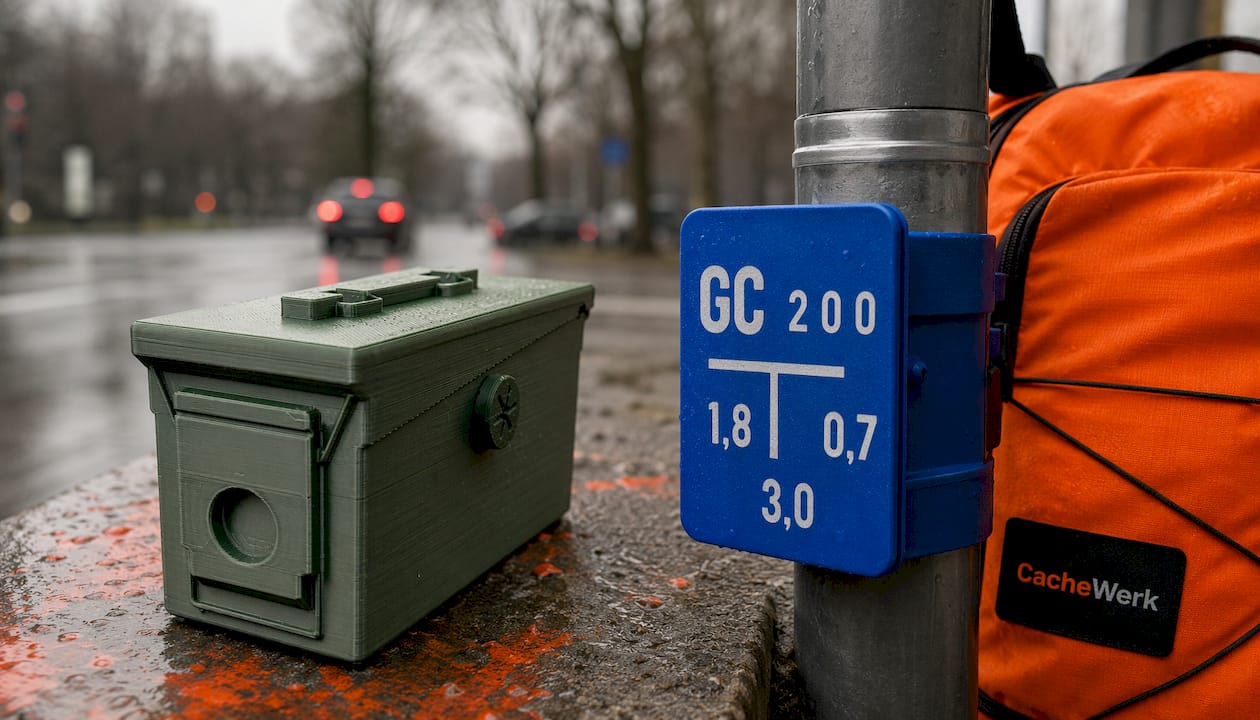
Cachewerk offers two products that address this exact issue. The Geocaching Ammo-Box Hide – Trick Edition looks like an ordinary object and blends so naturally into the environment that finders can quickly narrow down the correct area. Less guesswork, fewer questions. The Fake Water Sign as an urban camouflage hide goes a step further: It appears completely inconspicuous in the cityscape and already provides finders with a clear context through its shape. Both hides reduce the need for spoilers because the design itself communicates where to look.
Check out the products directly at Cachewerk and find the right hide for your next cache.
Key Takeaways
A well-used spoiler protects the environment, prevents frustration, and still respects the player experience of all finders.
| Topic | Details |
|---|---|
| Definition of Spoiler | Hint, photo, or text that directly reveals the hiding spot or puzzle solution. |
| Spoiler vs. Hint | A hint suggests; a spoiler reveals. Ensure opt-in through encryption or marking. |
| Technical Implementation | Name image as "Spoiler," remove EXIF, encrypt text with ROT13. |
| Community Etiquette | Never spoil in the log; offer help via private message. |
| Cachewerk Solution | Ammo-Box Trick Edition and Fake Water Sign reduce the need for spoilers through better camouflage. |
Spoilers from a pragmatic perspective
Spoilers have a tough time in the geocaching community. Unjustly so, if used correctly. The real question is not whether a spoiler diminishes the experience, but whether a poorly thought-out listing does. A hide that simply cannot be found without a spoiler is not a good hide. A spoiler, clearly marked and available as a last resort, however, is a sign of respect for the community.
What bothers me about the discussion: Many owners avoid spoilers on principle and instead leave vague hints that help no one. That's not a challenge. That's frustration. Anyone who truly knows their hide also knows when a clear hint does more good than silence. And anyone who builds a hide that explains itself needs neither.
Useful sources and further links
For those who want to delve deeper, these sources are particularly helpful:
CacheWiki – Spoiler: The most comprehensive German explanation on the topic. Covers definition, technology, and community etiquette. Ideal as a reference for owners. cachewiki.de/wiki/Spoiler
Geocaching.com Glossary: The official English definition from Geocaching.com. Concise and authoritative. geocaching.com/about/glossary.aspx
Geocaching.com Blog – Take the hint: Practical recommendations from the platform on when spoiler photos are useful and how to use them. geocaching.com/blog
Geoclub Forum – Spoiler Photos: Experience reports from the German community on gallery behavior and image labeling. geoclub.de
Saarfuchs on Tour: Opinion piece on the community discussion about spoilers. Shows how differently geocachers view the topic. saarfuchs.com
Cachewerk Blog: Practical tips for creative urban hides and camouflage solutions that reduce the need for spoilers from the outset. Also useful for anyone who wants to pay attention to the right footwear while geocaching.