
Why use individual hideouts: The big advantage
Custom geocache hides are tailor-made containers and camouflages specifically designed for a particular location, story, or target audience. Understanding why it makes sense to use custom hides lays the foundation for caches that delight, rather than frustrate, finders. Creative camouflage, clear hint communication, and rule-compliant planning make the difference between a forgotten nano-magnet and a cache that gets logged for years. This article shows you how to use creativity, the right attributes, and some planning to build hides that truly stick in people's minds.
Why using custom hides improves the search experience
A custom hide doesn't start with the container, but with the experience. Finders come with certain expectations: How difficult is the search? Do I need tools? Is the terrain suitable for children? Answering these questions in the listing ensures a positive experience from the start.
Geocaching attributes are the most important tool for this. Up to 15 attributes can be chosen per cache, signaling equipment, time required, and accessibility. This means that by carefully selecting your attributes, you filter out the right finders and prevent someone with a stroller from showing up at a climbing cache.
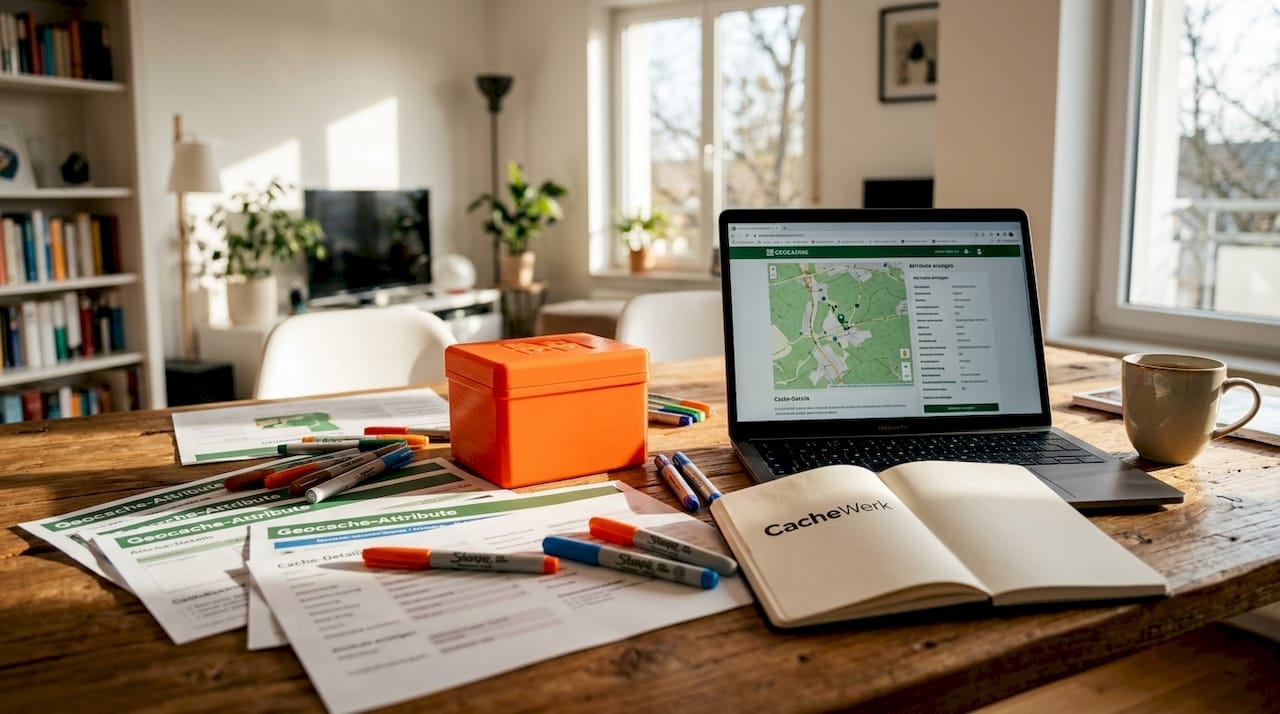
The benefits of custom hides are particularly evident during discovery. A well-camouflaged, thematically consistent cache creates genuine surprise. That moment when the finder suddenly understands how the hide works is the core of the geocaching experience. Standard off-the-shelf hides rarely deliver this moment.
Frustration almost always arises from poor coordination between the listing and the physical hide. Clear hints in the listing prevent incorrect equipment and negative search feelings. Someone who designs their hide individually automatically thinks more deeply about this coordination than someone who simply places a film canister under a rock.
- Expectation management: Attributes and listing texts clarify difficulty, terrain, and required equipment.
- Moment of surprise: Thematically appropriate camouflage creates genuine joy upon discovery.
- Frustration avoidance: Consistent hints between listing and hide reduce failed searches.
- Community spirit: Creative caches are more frequently logged, commented on, and recommended.
Pro-tip: Write your listing text from the perspective of a finder who doesn't yet know the cache. If you're not sure what equipment is needed, your finders won't know either.
Creativity and camouflage: Success factors for custom cache hides
Camouflage is not decoration. It is the core task of a good hider. The goal is: The cache should be invisible to Muggles, but remain discoverable for geocachers. This balancing act only succeeds with well-thought-out design.
The 2026 trend in geocaching clearly points towards “Hidden in plain sight,” especially in urban areas. This means: Hides should look like they belong in the environment. A screw on a metal railing, a chewing gum machine on a house wall, a stone on a wall ledge. These camouflages work because they deceive the observer's eye without being elaborate.
“The best hide is the one no one searches for because it looks like it has always been there.”
Here are proven methods for creative, custom hides:
- Material adaptation: Use materials that match the environment. Concrete look for city walls, bark texture for forest trees, rust finish for old metal structures.
- Form fidelity: The container should imitate the shape of an everyday object. Screw heads, bolts, stones, or tree stumps are classic examples.
- Functional accessibility: Camouflage must not sacrifice usability. A magnetic clasp must work even with cold fingers. A screw cap must not rust shut.
- Thematic consistency: The hide should match the location. A pirate cache at the harbor feels right. The same cache in the city park feels out of place.
- Weather resistance: Especially for custom-designed containers: Paint, adhesive, and materials must withstand rain, frost, and UV radiation.
Cachewerk offers, among other things, 3D-printed special items made of PETG, a material that is particularly weather-resistant and dimensionally stable. This makes a big difference for hides that stay outdoors all year round.
Rule-compliant planning: How to implement custom hides correctly
Creativity without knowledge of the rules leads to rejected listings. The official Geocaching guidelines set clear boundaries that you must know before placing your cache.
The most important principle: Caches must be at least 161 meters from other caches and may not be buried without permission. Anyone who falls short of this minimum distance risks automatic rejection by the reviewer. This sounds like a small hurdle, but in densely populated urban areas, it is a real planning challenge.
For public areas, the following also applies: Permission from the landowner is mandatory in many cases. Without this permission, the listing will be rejected. This affects parks, nature reserves, train stations, and other public places. A quick chat with the responsible authority is often enough, but it protects you from later problems.
| Planning step | Requirement | Consequence of violation |
|---|---|---|
| Minimum distance | 161 meters to other caches | Rejection by reviewer |
| Landowner permission | Written permission for public land | Listing will not be published |
| Container choice | Waterproof, no glass containers, no burying without permission | Cache will be archived |
| Setting attributes | Specify at least terrain and difficulty | Poor finder experience |
| Maintenance plan | Regular inspection and maintenance | Negative logs, cache will be archived |
Since 2026, the official Geocaching app allows direct creation of Traditional Cache listings including coordinates, attributes, images, and difficulty rating. This makes submission significantly easier and reduces errors in the initial submission.
Pro-tip: Photograph your cache before submission from a finder's perspective. If you can't find it yourself in the photo right away, the camouflage is good. If it stands out immediately, you need to improve it.
Maintenance is not an optional bonus, but a duty. A cache with wet logs, broken latches, or missing pencils will receive negative logs and eventually be archived. Plan from the outset how often you can check your cache and choose materials that make this maintenance interval realistic.
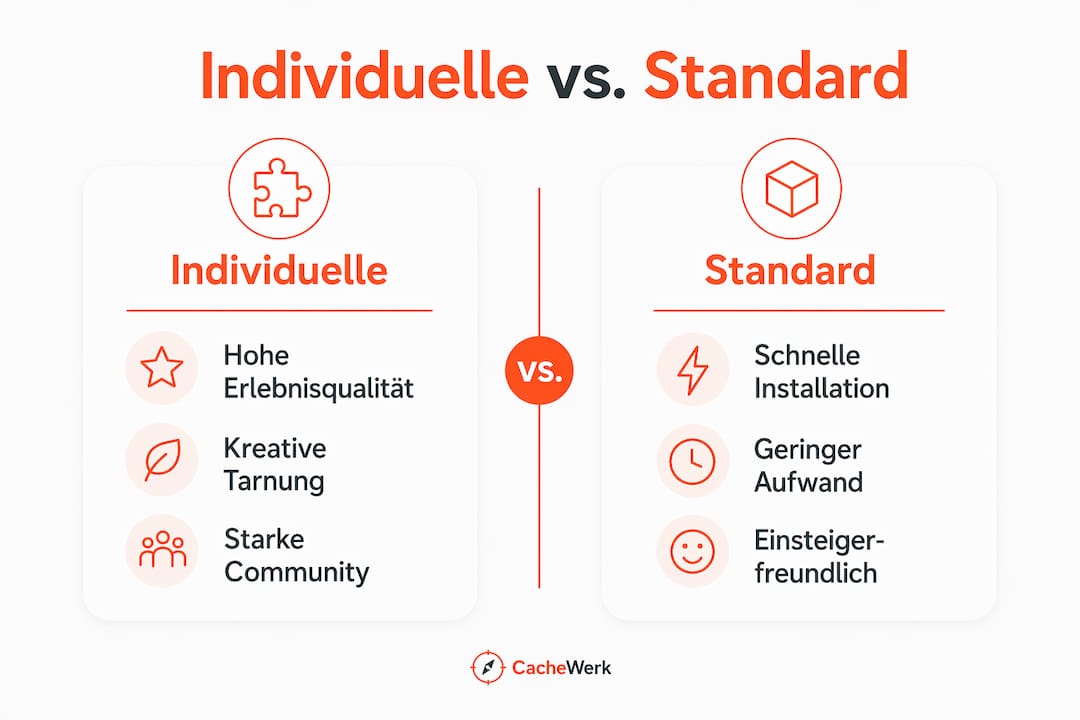
Custom Hides versus Standard Hides: Which is better?
Both approaches have their merits. The decision depends on your goals, your time budget, and the planned location.
| Criterion | Custom Hide | Standard Hide |
|---|---|---|
| Experience quality | High, due to surprise and theme | Medium, predictable |
| Maintenance effort | Higher, more components | Low, easy replacement |
| Cost | Higher for custom fabrication | Low, mass-produced |
| Rule compliance | Requires more planning | Easier to implement |
| Community response | More logs, favorites, recommendations | Less attention |
| Durability | High with good materials | Medium, often cheap plastic |
Custom hides clearly win on experience quality. Creative, well-communicated caches sustainably enhance the sense of community and enjoyment of the game. This is reflected in the number of favorite points: Caches with original camouflage and a coherent theme collect significantly more favorites than generic film canisters.
However, standard hides have their strengths:
- They are quick to place and easy to maintain.
- They are suitable for places where camouflage doesn't matter.
- They are ideal for beginners who want to gain experience first.
- They work well as part of a series where the experience comes from the route, not from the individual hide.
The honest answer is: Anyone who wants to be actively involved in the geocaching community in the long term cannot avoid custom hides. A single well-designed cache with 50 favorite points does more for your reputation as a hider than twenty generic containers. The effort is worth it if you are willing to bear it in the long term.
For beginners, a hybrid approach is recommended: Start with a simple container, but invest in good camouflage and a well-thought-out listing. This gives you the best of both worlds without overwhelming you.
Key Takeaways
Custom hides are the superior choice for geocachers who want to create lasting experiences and achieve strong community resonance.
| Point | Details |
|---|---|
| Use attributes strategically | Up to 15 attributes manage expectations and measurably improve the finder experience. |
| Choose camouflage to match the environment | Materials and form must match the surroundings so that Muggles overlook the cache. |
| Plan rule compliance from the start | Minimum distance of 161 meters and landowner permission are mandatory, not optional. |
| Plan maintenance realistically | Weather-resistant materials and regular checks ensure the longevity of the cache. |
| Custom caches get more favorites | Creative hides receive more logs and recommendations than generic standard solutions. |
My Experience with Custom Hides in Geocaching
Over the past few years, I've hidden many caches and found even more. And I'll tell you straight: the difference between a well-thought-out custom hide and a quickly placed film canister is enormous. Not just for the finder, but for you as the hider too.
What surprised me most: the effort for a good hide lies less in the material than in the planning. A 3D-printed screw head made of PETG doesn't cost much. But the consideration of where it sits, how it's attached, which attributes I set, and how I phrase the listing – that's the real work. And precisely this work pays off.
What I recommend to beginners: Start with a place you know well. A place that means something to you. Then consider what story you can tell there. The hide follows the story, not the other way around. Anyone who approaches it this way automatically builds better caches.
Advanced hiders should know Cachewerk's Outdoor Cache Hide Guide. There you'll find concrete case studies and ideas that you can implement directly. Especially the combination of camouflage and thematic listing has brought me many favorite points personally.
My honest advice: Avoid the mistake of wanting too much at once. A single, really good cache is worth more than five mediocre ones. Quality always beats quantity in geocaching.
— Benedikt
Implementing your next hide with Cachewerk
You now know why custom hides make all the difference. Now it's about putting that knowledge into practice. Cachewerk has exactly the assortment you need for this.
From weatherproof containers to urban camouflage and 3D-printed specialty hides made of PETG, you'll find everything for your next project at Cachewerk. The products are specially developed for geocaching enthusiasts who want more than a film canister under a rock. Check out the geocaching equipment and accessories and find the right container for your next cache. If you prefer to print yourself, Cachewerk also offers 3D printing templates for hides that are optimized directly for home printers.
FAQ
What makes a custom geocache hide better than a standard hide?
Custom hides create a genuine moment of surprise through creative camouflage and thematic consistency. They accumulate more favorite points and are more frequently recommended in the community than generic containers.
How many attributes should I set for my cache?
The official Geocaching platform allows up to 15 attributes per cache. Set at least terrain, difficulty, and relevant equipment hints so finders arrive well-prepared.
Do I need permission for my cache location?
For public areas, permission from the landowner is mandatory in many cases. Without this permission, the listing will be rejected by the reviewer, regardless of the quality of the hide.
What is the minimum distance between two caches?
Caches must be at least 528 feet, or about 161 meters, apart. This distance is a fixed rule of the official Geocaching guidelines and is automatically checked.
What materials are best suited for custom hides?
PETG is particularly suitable for 3D-printed hides as it is weather-resistant, dimensionally stable, and durable. For camouflage, materials that optically match the surroundings are recommended, such as concrete, bark, or metal textures, depending on the location.